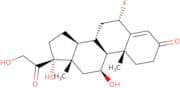
CAS 1053-58-3
:6-alpha-Fluorhydrocortisone
Description:
6-alpha-Fluorhydrocortisone, with the CAS number 1053-58-3, is a synthetic corticosteroid that exhibits anti-inflammatory and immunosuppressive properties. It is a fluorinated derivative of hydrocortisone, which enhances its potency and alters its pharmacokinetic profile. This compound is characterized by its ability to bind to glucocorticoid receptors, leading to a range of biological effects, including the modulation of gene expression involved in inflammation and immune responses. The presence of the fluorine atom at the 6-alpha position contributes to its increased stability and efficacy compared to non-fluorinated corticosteroids. 6-alpha-Fluorhydrocortisone is typically administered in various formulations for therapeutic purposes, including the treatment of conditions such as allergies, autoimmune disorders, and certain types of inflammation. Its pharmacological effects can include the reduction of swelling, redness, and pain, making it a valuable agent in clinical settings. However, like other corticosteroids, it may also have side effects, particularly with long-term use, necessitating careful monitoring and management by healthcare professionals.
Formula:C21H29FO5
InChI:InChI=1/C21H29FO5/c1-19-5-3-11(24)7-14(19)15(22)8-12-13-4-6-21(27,17(26)10-23)20(13,2)9-16(25)18(12)19/h7,12-13,15-16,18,23,25,27H,3-6,8-10H2,1-2H3/t12-,13-,15-,16-,18+,19-,20-,21-/m0/s1
Synonyms:- 6-a-Fluor-Hydrocortisone
- (6Alpha,11Beta)-6-Fluoro-11,17,21-Trihydroxypregn-4-Ene-3,20-Dione
Sort by
Purity (%)
0
100
|
0
|
50
|
90
|
95
|
100
Found 1 products.
(6S,8S,9S,10R,11S,13S,14S,17R)-6-Fluoro-11,17-Dihydroxy-17-(2-Hydroxyacetyl)-10,13-Dimethyl-2,6,7,8,9,11,12,14,15,16-Decahydro-1H-Cy clopenta[a]Phenanthren-3-One
CAS:Controlled ProductThe compound is an orally active, non-steroidal, anti-inflammatory drug that has been shown to be effective in renal transplantation and the treatment of insulin resistance. It is a prodrug which is converted to its active form by esterases and glucuronidases in the liver. The metabolite binds to mineralocorticoid receptors in the kidney, thereby inhibiting the synthesis of aldosterone, which causes increased blood pressure. This mechanism leads to decreased urinary excretion of sodium and water, thereby reducing blood volume. The compound also binds to cancer cells through receptor binding and has been shown to inhibit tumor growth. This drug is biocompatible with polymeric matrices and can be used as magnetic particles for diagnostic purposes or as contrast agents for imaging purposes when coupled with MRI or CT techniques.Formula:C21H29FO5Purity:Min. 95%Molecular weight:380.45 g/mol