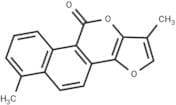
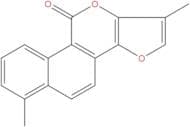
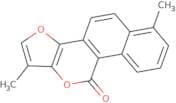
![10H-Furo[3,2-b]naphtho[2,1-d]pyran-10-one,1,6-dimethyl-](/_next/image/?url=https%3A%2Fstatic.cymitquimica.com%2Fcas-image%2Fthumb-webp%2F399985-10h-furo-32-b-naphtho-21-d-pyran-10-one-16-dimethyl.webp&w=3840&q=75)
CAS 105351-70-0
:10H-Furo[3,2-b]naphtho[2,1-d]pyran-10-one,1,6-dimethyl-
Description:
10H-Furo[3,2-b]naphtho[2,1-d]pyran-10-one, 1,6-dimethyl- is a synthetic organic compound characterized by its complex polycyclic structure, which includes a fused naphthalene and pyran ring system. This compound typically exhibits properties associated with both aromatic and heterocyclic compounds, contributing to its potential applications in various fields, including organic synthesis and materials science. The presence of multiple functional groups, such as the furan and ketone moieties, suggests that it may participate in various chemical reactions, including electrophilic substitutions and nucleophilic additions. Additionally, the dimethyl substitutions at the 1 and 6 positions can influence its solubility, reactivity, and overall stability. While specific physical properties such as melting point, boiling point, and solubility may vary, compounds of this type are often studied for their biological activities, including potential antioxidant or anti-inflammatory effects. As with many organic compounds, safety data and handling precautions should be considered when working with this substance in a laboratory setting.
Formula:C17H12O3
Synonyms:- Tanshinlactone
Sort by
Purity (%)
0
100
|
0
|
50
|
90
|
95
|
100
Found 4 products.
Tanshinlactone
CAS:Tanshinlactone is a natural product of Salvia, Lamiaceae.Formula:C17H12O3Purity:98%Color and Shape:SolidMolecular weight:264.28Tanshinlactone
CAS:Tanshinlactone is a diterpene quinone compound, which is derived from the root of the plant Salvia miltiorrhiza, commonly known as Danshen. This compound is part of a class of natural products that possess notable bioactivities. Tanshinlactone exhibits its mode of action primarily through the induction of apoptosis in cancer cells. It destabilizes mitochondrial membranes, leading to the release of cytochrome c and activation of caspases, which signals the apoptotic pathway.Formula:C17H12O3Purity:Min. 95%Molecular weight:264.27 g/mol