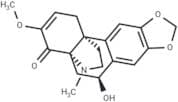
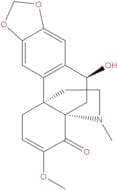
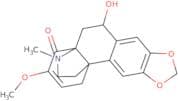
![(4aS,6S,11bR)-6-hydroxy-3-methoxy-14-methyl-5,6-dihydro-4a,11b-(epiminoethano)phenanthro[2,3-d][1,…](/_next/image/?url=https%3A%2Fstatic.cymitquimica.com%2Fcas-image%2Fthumb-webp%2F392169-4as-6s-11br-6-hydroxy-3-methoxy-14-methyl-56-dihydro-4a-11b-epiminoethano-phenanthro-23-d-13-dioxol-4-1h-one.webp&w=3840&q=75)
CAS 105608-27-3
:(4aS,6S,11bR)-6-hydroxy-3-methoxy-14-methyl-5,6-dihydro-4a,11b-(epiminoethano)phenanthro[2,3-d][1,3]dioxol-4(1H)-one
Description:
The chemical substance known as "(4aS,6S,11bR)-6-hydroxy-3-methoxy-14-methyl-5,6-dihydro-4a,11b-(epiminoethano)phenanthro[2,3-d][1,3]dioxol-4(1H)-one," with the CAS number 105608-27-3, is a complex organic compound characterized by its unique stereochemistry and functional groups. It features a phenanthro[2,3-d][1,3]dioxole core, which contributes to its structural complexity and potential biological activity. The presence of hydroxyl (-OH) and methoxy (-OCH3) groups indicates that it may exhibit polar characteristics, influencing its solubility and reactivity. The compound's stereocenters suggest that it may have specific interactions in biological systems, potentially affecting its pharmacological properties. Additionally, the presence of a dihydro structure implies that it may participate in various chemical reactions, including oxidation and reduction processes. Overall, this compound's intricate structure and functional groups make it a subject of interest in medicinal chemistry and drug development, although specific biological activities and applications would require further investigation.
Formula:C19H21NO5
InChI:InChI=1/C19H21NO5/c1-20-6-5-18-4-3-14(23-2)17(22)19(18,20)9-13(21)11-7-15-16(8-12(11)18)25-10-24-15/h3,7-8,13,21H,4-6,9-10H2,1-2H3/t13-,18+,19+/m0/s1
Sort by
Purity (%)
0
100
|
0
|
50
|
90
|
95
|
100
Found 4 products.
Prostephanaberrine
CAS:Prostephanaberrine is a natural product from Stephania japonica.Formula:C19H21NO5Purity:98%Color and Shape:SolidMolecular weight:343.37Prostephanaberrine
CAS:Controlled ProductProstephanaberrine is an alkaloid compound, which is naturally derived from the Stephania species of plants. Its source lies in the potent bioactive constituents found in these plants, which are renowned in traditional medicine systems for their therapeutic potentials. The mode of action of Prostephanaberrine is centered around its interaction with specific biochemical pathways, potentially influencing various physiological processes through receptor modulation and enzymatic pathway interactions. This mechanism suggests potential applications in the study of neurological disorders, owing to its influence on neurotransmitter systems.
Formula:C19H21NO5Purity:Min. 95%Molecular weight:343.4 g/mol