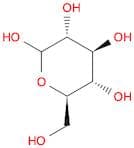
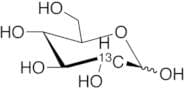
CAS 105931-74-6
:D-Glucopyranose-2-13C
Description:
D-Glucopyranose-2-13C is a stable isotope-labeled form of D-glucose, specifically featuring a carbon-13 isotope at the second carbon position of the glucopyranose ring. This compound retains the fundamental characteristics of D-glucose, including its molecular formula, which is C6H12O6, but with the substitution of a carbon-13 atom, making it useful in various analytical applications. D-Glucopyranose-2-13C is typically utilized in metabolic studies, tracer experiments, and NMR spectroscopy, allowing researchers to track metabolic pathways and understand carbohydrate metabolism in biological systems. The presence of the carbon-13 isotope enhances the sensitivity and resolution of NMR signals, facilitating detailed structural and dynamic studies. As a monosaccharide, it is soluble in water and exhibits the typical reactivity of carbohydrates, including participation in glycosidic bond formation and fermentation processes. Its stable isotope nature makes it non-radioactive and safe for use in laboratory settings.
Formula:C6H12O6
InChI:InChI=1S/C6H12O6/c7-1-2-3(8)4(9)5(10)6(11)12-2/h2-11H,1H2/t2-,3-,4+,5-,6?/m1/s1/i5+1
InChI key:InChIKey=WQZGKKKJIJFFOK-UKLRSMCWSA-N
SMILES:C(O)[C@@H]1[C@@H](O)[C@H](O)[13C@@H](O)C(O)O1
Synonyms:- <span class="text-smallcaps">D</span>-Glucopyranose-2-<sup>13</sup>C
- α-D-(2-13C)glucopyranose
- D-Glucopyranose-2-13C
Sort by
The purity filter is not visible because current products do not have associated purity data for filtering.
Found 2 products.
D-Glucose-2-13C
CAS:Controlled Product<p>Applications Labelled D-Glucose is a simple sugar that is present in plants. A monosaccharide that may exist in open chain or cyclic conformation if in solution. It plays a vital role in photosynthesis and fuels the energy required for cellular respiration. D-Glucose is used in various metabolic processes including enzymic synthesis of cyclohexyl-α and β-D-glucosides. Can also be used as a diagnostic tool in detection of type 2 diabetes mellitus and potentially Huntington's disease through analysis of blood-glucose in type 1 diabetes mellitus.<br>References Wang, R., et al.: J. Mol. Catal. B. Enz., 56, 131 (2009); Springhorn, C. et al.: J. Clin. Endocrinol. Metab., 97, 4640 (2012); Hashimoto, K. et al.: J. Clin. Endocrinol. Metab., 97, 3016 (2012); Avelange, M. et al.: Plant. Phys., 94, 1157 (1990); Cramer, C. et al.: J. Chem. Soc., 115, 5745 (1993);<br></p>Formula:C513CH12O6Color and Shape:NeatMolecular weight:181.15