CAS 1060805-66-4
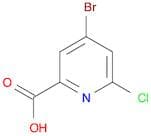
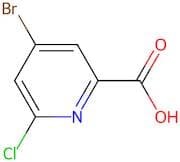
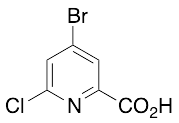
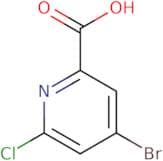
:4-Bromo-6-chloro-2-pyridinecarboxylic acid
Description:
4-Bromo-6-chloro-2-pyridinecarboxylic acid is a heterocyclic organic compound characterized by the presence of both bromine and chlorine substituents on a pyridine ring, along with a carboxylic acid functional group. This compound features a pyridine ring, which is a six-membered aromatic ring containing one nitrogen atom, contributing to its basicity and potential reactivity. The bromine and chlorine atoms introduce significant electronegativity, influencing the compound's chemical behavior and reactivity. As a carboxylic acid, it exhibits acidic properties, allowing it to participate in various chemical reactions, such as esterification and amidation. The presence of halogens can also enhance its reactivity in nucleophilic substitution reactions. This compound may find applications in pharmaceuticals, agrochemicals, or as an intermediate in organic synthesis due to its unique structural features. Its physical properties, such as solubility and melting point, would depend on the specific conditions and the presence of other solvents or reagents.
Formula:C6H3BrClNO2
Synonyms:- 2-Pyridinecarboxylic acid, 4-bromo-6-chloro-
- 4-Bromo-6-chloropicolinic acid
Sort by
Purity (%)
0
100
|
0
|
50
|
90
|
95
|
100
Found 5 products.
4-Bromo-6-chloropicolinic acid
CAS:Formula:C6H3BrClNO2Purity:98%Color and Shape:SolidMolecular weight:236.45054-Bromo-6-chloropicolinic acid
CAS:4-Bromo-6-chloropicolinic acidPurity:97%Molecular weight:236.45g/mol4-Bromo-6-chloropicolinic acid
CAS:Formula:C6H3BrClNO2Purity:97%Color and Shape:SolidMolecular weight:236.454-Bromo-6-chloro-2-pyridinecarboxylic Acid
CAS:Controlled ProductFormula:C6H3BrClNO2Color and Shape:NeatMolecular weight:236.4514-Bromo-6-chloropicolinic acid
CAS:4-Bromo-6-chloropicolinic acid is a chemical that can be produced by reacting phosphorus oxychloride and phosphorus pentachloride. It is used as a reagent in organic synthesis. The oxidation reaction of 4-bromo-6-chloropicolinic acid with tetrabutylammonium pentabromide has been extensively studied and has been shown to produce 2,4,6-trichlorophenol.Formula:C6H3BrClNO2Purity:Min. 95%Molecular weight:236.45 g/mol