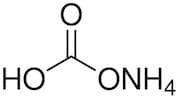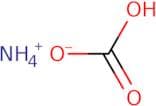
CAS 1066-33-7
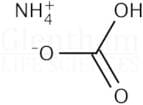
:Ammonium bicarbonate
Description:
Ammonium bicarbonate, with the CAS number 1066-33-7, is an inorganic compound that appears as a white crystalline solid. It is commonly used as a leavening agent in baking and as a source of ammonia in various chemical processes. The compound is soluble in water, where it dissociates into ammonium ions and bicarbonate ions, contributing to its alkaline properties. Ammonium bicarbonate decomposes upon heating, releasing ammonia, carbon dioxide, and water, which can be utilized in certain applications such as fertilizers and food production. It has a relatively low melting point and is stable under normal conditions, but it should be stored in a cool, dry place to prevent moisture absorption and degradation. Additionally, it is considered non-toxic and safe for use in food products, although inhalation of its dust can cause respiratory irritation. Overall, ammonium bicarbonate is valued for its versatility in both culinary and industrial applications.
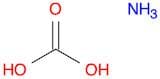
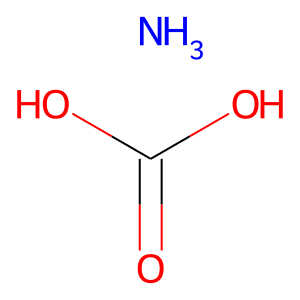
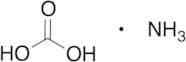
Formula:CH2O3·H3N
InChI:InChI=1S/CH2O3.H3N/c2-1(3)4;/h(H2,2,3,4);1H3
InChI key:InChIKey=ATRRKUHOCOJYRX-UHFFFAOYSA-N
SMILES:C(=O)(O)O.N
Synonyms:- Acid Ammonium Carbonate
- AmBic
- Ammoninum Bicarbonate
- Ammonium Hydrogencarbonate
- Ammonium Zinc Carbonate (2:2:3)
- Ammonium acid carbonate
- Ammonium bicarbonate ((NH4)HCO3)
- Ammonium bicarbonate ((NH<sub>4</sub>)HCO<sub>3</sub>)
- Ammonium hydrogen carbonate
- Ammonium hydrogenocarbonate
- Ammoniumhydrogencarbonat
- Carbonic Acid, Monoammonium Salt
- Carbonic acid, ammonium salt (1:1)
- Hidrogenocarbonato De Amonio
- Hydrogenocarbonate d'ammonium
- Monoammonium carbonate
- See more synonyms
Sort by
Purity (%)
0
100
|
0
|
50
|
90
|
95
|
100
Found 9 products.
Ammonium hydrogen carbonate, 98%
CAS:This Thermo Scientific Chemicals brand product was originally part of the Alfa Aesar product portfolio. Some documentation and label information may refer to the legacy brand. The original Alfa Aesar product / item code or SKU reference has not changed as a part of the brand transition to Thermo SciFormula:CH5NO3Purity:98%Color and Shape:White, Crystals or powder or crystalline powder or fused solidMolecular weight:79.06Ammonium hydrogen carbonate, 99.0%
CAS:In cooling baths, fire extinguishing compounds, baking powder formulations, and in the manufacture of ceramics and pigments. Also used for compost treatment to accelerate decomposition.Ammonium hydrogen carbonate is used as a reagent in chemical industries. It is an active component used in the maFormula:CH5NO3Purity:99.0%Molecular weight:79.06Ammonium bicarbonate
CAS:Formula:NH4HCO3Purity:98.5 - 101.0 %Color and Shape:White crystalline powderMolecular weight:79.06Ammonium bicarbonate
CAS:Formula:CH5NO3Purity:99.0%Color and Shape:Solid, Crystalline PowderMolecular weight:79.055Ammonium Bicarbonate
CAS:Controlled ProductApplications Ammonium Bicarbonate is a useful reagent in the synthesis of double-shelled CoMn2O5 hollow microcubes used as anode material for lithium-ion batteries.
References Zhou, L., et al.: Adv. Mater., 24, 745 (2012);Formula:CH5NO3Color and Shape:NeatMolecular weight:79.06Ammonium Bicarbonate extrapure AR (Ammonium Hydrogen Carbonate), 99%
CAS:Formula:NH5CO3Purity:min. 99%Color and Shape:White, Crystalline powder, Clear, ColourlessMolecular weight:79.06Ammonium bicarbonate
CAS:Ammonium bicarbonate is a substance that has been used as a buffer to maintain pH in wastewater treatment. Ammonium bicarbonate has also been shown to be effective in the treatment of metabolic disorders, such as glycogen storage diseases and urea cycle disorders. Ammonium bicarbonate is synthesized by reacting aqueous solutions of ammonium chloride and sodium or potassium carbonate. It can also be produced through the reaction of ammonia with carbon dioxide in water vapor. The analytical method for ammonium bicarbonate is based on the reaction with trifluoroacetic acid (TFA) and the formation of ammonium trifluoroacetate. This compound can react with water to produce carbon dioxide and ammonia, which may function as a nutrient solution for microorganisms. Cyclic nucleotide phosphodiesterases are enzymes that break down cyclic nucleotides, which are important for many physiological functions, including muscle contraction and regulation of blood pressureFormula:CH5NO3Purity:Min. 95%Color and Shape:White SolidMolecular weight:79.06 g/mol