CAS 106921-60-2
:2,2-Dimethyl-3-oxopentanal
Description:
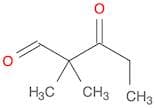
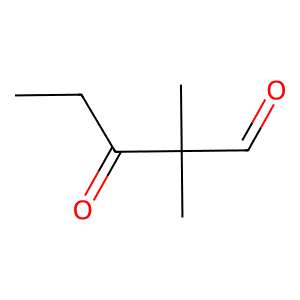
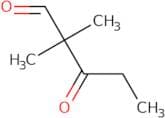
2,2-Dimethyl-3-oxopentanal, with the CAS number 106921-60-2, is an organic compound characterized by its aldehyde functional group and a ketone group within its structure. This compound features a five-carbon chain with two methyl groups attached to the second carbon and a ketone group at the third carbon, contributing to its reactivity and potential applications in organic synthesis. It is typically a colorless to pale yellow liquid with a distinctive odor. The presence of both the aldehyde and ketone functionalities allows for various chemical reactions, including nucleophilic additions and condensation reactions. Its molecular structure suggests it may participate in reactions typical of aldehydes and ketones, such as oxidation and reduction. Additionally, due to its unique structure, it may serve as an intermediate in the synthesis of more complex organic molecules. Safety data should be consulted for handling and storage, as with many organic compounds, it may pose health risks if not managed properly.
Formula:C7H12O2
InChI:InChI=1S/C7H12O2/c1-4-6(9)7(2,3)5-8/h5H,4H2,1-3H3
InChI key:InChIKey=PVYBKZHBCCMBPS-UHFFFAOYSA-N
SMILES:C(C(CC)=O)(C=O)(C)C
Synonyms:- Pentanal, 2,2-dimethyl-3-oxo-
- 2,2-Dimethyl-3-oxopentanal
Sort by
Purity (%)
0
100
|
0
|
50
|
90
|
95
|
100
Found 4 products.
2,2-dimethyl-3-oxopentanal
CAS:Formula:C7H12O2Purity:95%Color and Shape:LiquidMolecular weight:128.16902,2-Dimethyl-3-oxopentanal
CAS:Formula:C7H12O2Purity:98% (stabilized with Citric acid)Molecular weight:128.1712,2-Dimethyl-3-oxopentanal
CAS:2,2-Dimethyl-3-oxopentanal is a molecule that forms during the oxidation of isobutene. It is involved in a variety of reactions and has been shown to have surface chemistry properties. The adsorption and desorption of 2,2-dimethyl-3-oxopentanal on a ruthenium surface has been studied by XPS and photoelectron spectroscopy. The molecule has also been shown to form from the gas phase reaction of monoxide and metallic rhodium. This molecule can be used as a ligand in coordination chemistry.Formula:C7H12O2Purity:Min. 95%Molecular weight:128.17 g/mol