![Poly[(+)-lactic acid]](/_next/image/?url=https%3A%2Fstatic.cymitquimica.com%2Fcas-image%2Fthumb-webp%2F479969-poly-lactic-acid.webp&w=3840&q=75)
CAS 106989-11-1
:Poly[(+)-lactic acid]
Description:
Poly[(+)-lactic acid], commonly referred to as PLA, is a biodegradable and bioactive thermoplastic derived from renewable resources, primarily corn starch or sugarcane. It is a member of the poly(lactic acid) family, characterized by its aliphatic polyester structure formed through the polymerization of lactic acid monomers. PLA exhibits excellent mechanical properties, including good tensile strength and flexibility, making it suitable for various applications, including packaging, textiles, and biomedical devices. Its melting temperature typically ranges from 150 to 180 degrees Celsius, and it has a glass transition temperature around 60 degrees Celsius. PLA is known for its biocompatibility and biodegradability, breaking down into non-toxic lactic acid under industrial composting conditions. This makes it an attractive alternative to petroleum-based plastics, particularly in environmentally conscious applications. Additionally, PLA can be processed using conventional plastic processing techniques, such as extrusion and injection molding, further enhancing its versatility in manufacturing.
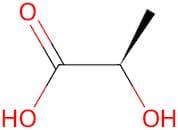
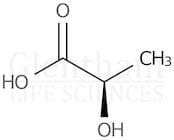
Formula:(C3H6O3)x
InChI:InChI=1S/C3H6O3/c1-2(4)3(5)6/h2,4H,1H3,(H,5,6)/t2-/m1/s1
InChI key:InChIKey=JVTAAEKCZFNVCJ-UWTATZPHSA-N
SMILES:[C@H](C(O)=O)(C)O
Synonyms:- D-Lactic acid polymer
- Propanoic acid, 2-hydroxy-, (2R)-, homopolymer
- Poly[(+)-lactic acid]
- D-Lactic acid homopolymer
- Propanoic acid, 2-hydroxy-, (R)-, homopolymer
Sort by
The purity filter is not visible because current products do not have associated purity data for filtering.
Found 2 products.