CAS 107-75-5
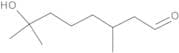
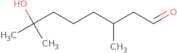
:Hydroxycitronellal
Description:
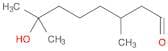
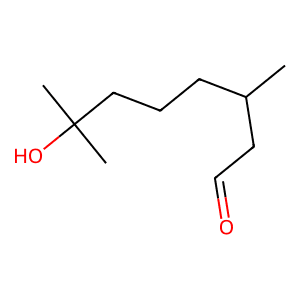
Hydroxycitronellal, with the CAS number 107-75-5, is an organic compound classified as a monoterpenoid and an aldehyde. It is a colorless to pale yellow liquid with a floral, citrus-like odor, making it a popular ingredient in perfumes and cosmetics. Hydroxycitronellal is soluble in alcohol and oils but has limited solubility in water. Its molecular formula is C10H18O, and it features a hydroxyl group (-OH) and an aldehyde group (-CHO), contributing to its reactivity and fragrance properties. This compound is often used as a fragrance enhancer and is also noted for its potential allergenic properties, which has led to regulatory scrutiny in cosmetic formulations. Additionally, hydroxycitronellal can be synthesized from citronellal, a natural component derived from essential oils. Its applications extend beyond perfumery to include use in flavoring agents and as a potential intermediate in organic synthesis. Safety data indicates that it should be handled with care, as it may cause skin irritation in sensitive individuals.
Formula:C10H20O2
InChI:InChI=1S/C10H20O2/c1-9(6-8-11)5-4-7-10(2,3)12/h8-9,12H,4-7H2,1-3H3
InChI key:InChIKey=WPFVBOQKRVRMJB-UHFFFAOYSA-N
SMILES:C(C(C)(C)O)CCC(CC=O)C
Synonyms:- (±)-Hydroxycitronellal
- 3,7-Dimethyl-7-Hydroxyoctanal
- 3,7-Dimethyl-7-hydroxyoctan-1-al
- 7-Hydroxy-3,7-dimethyloctanal
- Citronellal hydrate
- Citronellal, hydroxy-
- Cyclalia
- Cyclosia
- Cyclosia base
- Fixol
- Laurine
- Lilyl aldehyde
- Muguet synthetic
- Muguettine principle
- NSC 406740
- Octanal, 7-hydroxy-3,7-dimethyl-
- See more synonyms
Sort by
Purity (%)
0
100
|
0
|
50
|
90
|
95
|
100
Found 7 products.
7-Hydroxy-3,7-dimethyloctanal
CAS:Formula:C10H20O2Purity:95%Color and Shape:LiquidMolecular weight:172.26467-Hydroxycitronellal
CAS:7-HydroxycitronellalFormula:C10H20O2Purity:95%Color and Shape: clear. colourless liquidMolecular weight:172.26g/mol7-Hydroxy-3,7-dimethyloctanal
CAS:7-Hydroxy-3,7-dimethyloctanal has extremely weak agonist activity against TRPM8 (EC50 = 1960 µM) and can be used in related research in the field of life sciences.Formula:C10H20O2Color and Shape:SolidMolecular weight:172.267-Hydroxycitronellal
CAS:Controlled ProductStability Air Sensitive
Applications 7-Hydroxycitronellal shows fungicide activity the strains of Candida tropicalis.
References Filho, O., et al.: Bioscience Journal, 33, 204 (2017)Formula:C10H20O2Color and Shape:NeatMolecular weight:172.267-Hydroxy-3,7-dimethyloctanal
CAS:Formula:C10H20O2Purity:95%Color and Shape:Liquid, No data available.Molecular weight:172.268Citronellal hydrate
CAS:Citronellal hydrate is a chemical substance that is found in many essential oils, such as citronella, lemon grass, and citronella. It has been shown to have significant effects on the human metabolism and urine samples. Citronellal hydrate can be used as a preservative due to its ability to inhibit bacterial growth, including bacteria that are resistant to benzalkonium chloride. Citronellal hydrate also has been shown to have an effect on cell maturation, which may be predictive for the development of cancer cells. Citronellal hydrate is present in many natural products that are used in cosmetics and personal care products. It is a good analytical method for identifying the presence of other chemicals in a sample because it has been shown to react with molecules such as alcohols, amines, ketones, esters, and ethers. Citronellal hydrate reacts with these molecules by altering their mass through an electron-transfer process called triple-Formula:C10H20O2Purity:Min. 95%Molecular weight:172.26 g/mol