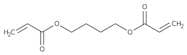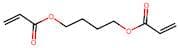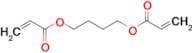
CAS 1070-70-8
:1,4-Butanediol diacrylate
Description:
1,4-Butanediol diacrylate (BDDA) is a diacrylate ester commonly used in polymer chemistry and materials science. It is characterized by its two acrylate functional groups, which enable it to participate in free radical polymerization, making it a valuable monomer in the production of crosslinked polymers and resins. BDDA is typically a colorless to pale yellow liquid with a low viscosity, and it has a relatively low boiling point. It is soluble in organic solvents such as acetone and ethyl acetate but is insoluble in water. The compound is known for its ability to enhance the mechanical properties and chemical resistance of the resulting polymers. However, it is also important to note that BDDA can be a skin and eye irritant, and appropriate safety measures should be taken when handling it. Its applications span various industries, including coatings, adhesives, and dental materials, where its crosslinking capabilities are particularly beneficial.
Formula:C10H14O4
InChI:InChI=1/C10H14O4.C2H6O2/c1-3-9(11)13-7-5-6-8-14-10(12)4-2;3-1-2-4/h3-4H,1-2,5-8H2;3-4H,1-2H2
InChI key:InChIKey=JHWGFJBTMHEZME-UHFFFAOYSA-N
SMILES:C(OCCCCOC(C=C)=O)(C=C)=O
Synonyms:- 1,4-Bis(acryloyloxy)butane
- 1,4-Butylene diacrylate
- 1,4-Butylene glycol diacrylate
- 1,4-Butyleneglycol diacrylate
- 2-Propenoic acid, 1,1′-(1,4-butanediyl) ester
- 2-Propenoic acid, 1,4-butanediyl ester
- Acrylic acid, tetramethylene ester
- Bdda
- Butane-1,1-Diyl Bisprop-2-Enoate
- Butane-1,4-Diyl Bisprop-2-Enoate
- Butane-1,4-diyl diacrylate
- Butylene glycol diacrylate
- Fa 124As
- Fancryl FA 124AS
- Fancryl FA 124SA
- Laromer BDDA
- M 204
- Miramer 204
- SR 213 (ester)
- Sartomer 213
- Sm 624
- Sr 213
- Tetramethylene acrylate
- Tetramethylene diacrylate
- Tetramethylene glycol diacrylate
- Viscoat 195
- Viscoat V 195
- n-Butane-1,4-diyl diacrylate
- 1,4-Butanediol, diacrylate
- 4-(Acryloyloxy)butyl acrylate
- ACRYLICACID,DIESTERWITH1,4-BUTANEDIOL
- acrylicacid,tetramethyleneester
- 1,4-BUTANEDIOL DIACRYLATE, TECH., 90%
- 2-Propenoicacid,1,4-butanediylester
- tetramethyleneacrylate
- 1,4-butanediyl diacrylate
- butylenediacrylate
- Butylene diacrylate
- sr213
- 1,4-butylenediacrylate
- See more synonyms
Sort by
Purity (%)
0
100
|
0
|
50
|
90
|
95
|
100
Found 5 products.
1,4-Butanediol diacrylate, 85+%, stab. with 50-105 ppm hydroquinone
CAS:1,4-Butanediol diacrylate is used as a multifunctional crosslinker. It is used in drying technology for paintings, coatings, inks, resins and adhesives. It serves as an intermediate product for polymer synthesis in the chemical industry. This Thermo Scientific Chemicals brand product was originallyFormula:C10H14O4Purity:85+%Color and Shape:Clear, viscous liquidMolecular weight:198.221,4-Butanediol Diacrylate
CAS:1,4-Butanediol DiacrylatePurity:90% (stabilized with 200~400ppm MEHQ)Molecular weight:198.22g/mol1,4-Bis(acryloyloxy)butane (stabilized with MEHQ)
CAS:Formula:C10H14O4Purity:>88.0%(GC)Color and Shape:Colorless to Light yellow to Light orange clear liquidMolecular weight:198.221,4-Bis(acryloyloxy)butane(stabilizedwithMEHQ)
CAS:Purity:85%(stabilized with MEHQ)Molecular weight:198.2181,4-Butanediol biscrylate - Hydroquinone as inhibitor
CAS:Controlled Product1,4-Butanediol biscrylate - Hydroquinone as inhibitor is a glycol ester that is used in the process of laser ablation. It has been shown to be a biocompatible polymer that can be used for surface methodology. This polymer is synthesized by reacting monosodium salt of butanediol with hydroquinone and sodium carbonate in aqueous solution. 1,4-Butanediol biscrylate - Hydroquinone as inhibitor has been tested using cervical cancer cells and it was found to have a cytotoxic effect on these cells.
Formula:C10H14O4Purity:Min. 95%Molecular weight:198.22 g/molRef: 3D-FB30663
Discontinued product