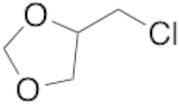
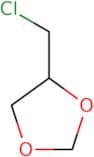
CAS 1072-61-3
:4-(chloromethyl)-1,3-dioxolane
Description:
4-(Chloromethyl)-1,3-dioxolane is a chemical compound characterized by its unique structure, which includes a dioxolane ring and a chloromethyl group. This compound is typically a colorless to pale yellow liquid with a distinctive odor. It is known for its reactivity due to the presence of the chloromethyl group, which can participate in nucleophilic substitution reactions. The dioxolane ring contributes to its stability and solubility in various organic solvents. This compound is often used as an intermediate in organic synthesis, particularly in the production of pharmaceuticals and agrochemicals. Its properties include moderate volatility and a relatively low boiling point, making it suitable for various applications in chemical synthesis. However, safety precautions should be taken when handling it, as it may pose health risks due to its chlorinated nature. Overall, 4-(chloromethyl)-1,3-dioxolane is a versatile compound with significant utility in synthetic organic chemistry.
Formula:C4H7ClO2
InChI:InChI=1/C4H7ClO2/c5-1-4-2-6-3-7-4/h4H,1-3H2
SMILES:C(C1COCO1)Cl
Sort by
Purity (%)
0
100
|
0
|
50
|
90
|
95
|
100
Found 2 products.
4-Chloromethyl-1,3-dioxolane
CAS:Controlled ProductFormula:C4H7ClO2Color and Shape:NeatMolecular weight:122.554-(Chloromethyl)-1,3-dioxolane
CAS:4-(Chloromethyl)-1,3-dioxolane is an active compound that belongs to the group of alkylation agents. It reacts with amines to form a new carbon-carbon bond between the amine nitrogen and the carbonyl oxygen. This reaction is called alkylation. The polyvinylchloride (PVC) model system was used to show the functional groups of this compound. The chlorine atom in 4-(chloromethyl)-1,3-dioxolane reacts with acid moieties in PVC to form chloroform and hydrogen chloride gas. The carboxylic acid moieties react with alkanolamide, which is a base, to form esterified products.Formula:C4H7ClO2Purity:Min. 95%Molecular weight:122.55 g/mol