CAS 107257-28-3
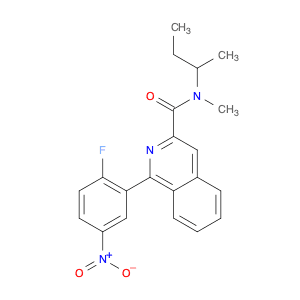
:N-(butan-2-yl)-1-(2-fluoro-5-nitrophenyl)-N-methylisoquinoline-3-carboxamide
Description:
N-(butan-2-yl)-1-(2-fluoro-5-nitrophenyl)-N-methylisoquinoline-3-carboxamide is a synthetic organic compound characterized by its complex structure, which includes an isoquinoline core, a carboxamide functional group, and a nitrophenyl moiety. The presence of a butan-2-yl group and a methyl group on the nitrogen atoms contributes to its lipophilicity, potentially influencing its solubility and permeability in biological systems. The fluorine and nitro substituents on the phenyl ring may impart unique electronic properties, affecting the compound's reactivity and interaction with biological targets. This compound is likely to exhibit specific pharmacological activities, making it of interest in medicinal chemistry. Its molecular structure suggests potential applications in drug development, particularly in targeting certain biological pathways. However, detailed studies on its biological activity, toxicity, and pharmacokinetics would be necessary to fully understand its characteristics and potential uses.
Formula:C21H20FN3O3
InChI:InChI=1/C21H20FN3O3/c1-4-13(2)24(3)21(26)19-11-14-7-5-6-8-16(14)20(23-19)17-12-15(25(27)28)9-10-18(17)22/h5-13H,4H2,1-3H3
SMILES:CCC(C)N(C)C(=O)c1cc2ccccc2c(c2cc(ccc2F)N(=O)=O)n1
Synonyms:- 1-(2-Fluoro-5-nitrophenyl)-N-methyl-N-(1-methylpropyl)-3-isoquinolinecarboxamide
- 3-Isoquinolinecarboxamide, 1-(2-fluoro-5-nitrophenyl)-N-methyl-N-(1-methylpropyl)-
Sort by
Purity (%)
0
100
|
0
|
50
|
90
|
95
|
100
Found 3 products.
PK14105
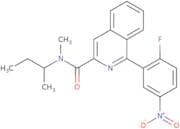
CAS:PK14105 is a benzodiazepine that has been shown to bind with high affinity to the benzodiazepine binding site on the gamma-aminobutyric acid receptor. It has been used in experimental models of conditions such as Parkinson's disease and schizophrenia, as well as for the treatment of cardiac arrhythmia. PK14105 also binds to the dopamine D2 receptor, which may be responsible for its anti-psychotic properties. The localization of PK14105 in mitochondria is thought to be responsible for its ability to inhibit mitochondrial functions and prevent cell death.Formula:C21H20FN3O3Purity:Min. 95%Molecular weight:381.4 g/molPK14105
CAS:PK14105: potential PET radioligand, crosses blood-brain barrier, retained in lesioned striatum, inhibits various neural ligands.Formula:C21H20FN3O3Purity:98%Color and Shape:SolidMolecular weight:381.4