CAS 1073-93-4
:N-Isopropylmaleimide
Description:
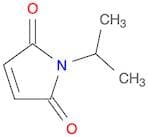
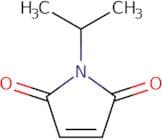
N-Isopropylmaleimide (CAS 1073-93-4) is a chemical compound characterized by its maleimide structure, which features a five-membered ring containing a carbonyl group and a nitrogen atom. It is a colorless to pale yellow solid at room temperature and is soluble in organic solvents such as acetone and dichloromethane. This compound is known for its reactivity, particularly in Michael addition reactions, where it can react with nucleophiles due to the presence of the maleimide double bond. N-Isopropylmaleimide is often utilized in polymer chemistry, particularly in the synthesis of thermosetting resins and as a crosslinking agent in various applications, including adhesives and coatings. Additionally, it has been studied for its potential use in biomedical applications, such as drug delivery systems and as a building block for functional materials. Safety considerations include handling it in a well-ventilated area and using appropriate personal protective equipment, as it may cause irritation upon contact with skin or eyes.
Formula:C7H9NO2
InChI:InChI=1S/C7H9NO2/c1-5(2)8-6(9)3-4-7(8)10/h3-5H,1-2H3
InChI key:InChIKey=NQDOCLXQTQYUDH-UHFFFAOYSA-N
SMILES:C(C)(C)N1C(=O)C=CC1=O
Synonyms:- (1R)-1-(4-nitrophenyl)ethanol
- 1-(1-Methylethyl)-1H-pyrrole-2,5-dione
- 1-(propan-2-yl)-1H-pyrrole-2,5-dione
- 1-Propan-2-Ylpyrrole-2,5-Dione
- 1H-Pyrrole-2,5-dione, 1-(1-methylethyl)-
- Maleimide, N-isopropyl-
- NSC 17658
- N-Isopropylmaleimide
- 1-Isopropyl-1H-pyrrole-2,5-dione
- 4-[2-(4-methoxyphenyl)ethynyl]-2-methyl-3-quinolinecarboxylic acid methyl ester
- 1-isopropyl-3-pyrroline-2,5-quinone
Sort by
Purity (%)
0
100
|
0
|
50
|
90
|
95
|
100
Found 2 products.
N-Isopropylmaleimide
CAS:N-Isopropylmaleimide is an organic compound that belongs to the group of catalysed compounds. It is used in biosynthesis, and it is also a metabolite of various fatty acid metabolites. N-Isopropylmaleimide catalyzes the hydrolysis of propionate to form pyruvate and acetic acid, which can be further oxidized to form acetaldehyde and carbon dioxide. The molecule has been shown to polymerize fatty acids and increase the growth rate of yeast cells in culture. It also reacts with orthophosphoric acid forming a protonated product, which is subsequently hydrolyzed by water.
Formula:C7H9NO2Purity:Min. 95%Color and Shape:PowderMolecular weight:139.15 g/mol