CAS 1075-76-9
:3-(Phenylamino)propanenitrile
Description:
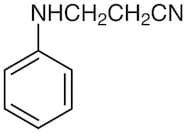
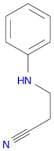
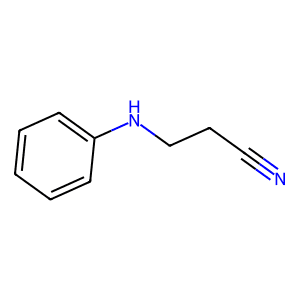
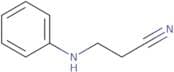
3-(Phenylamino)propanenitrile, with the CAS number 1075-76-9, is an organic compound characterized by the presence of a nitrile functional group and an amino group attached to a propyl chain. This compound features a phenyl group, which is a benzene ring attached to the amino group, contributing to its aromatic properties. The structure consists of a three-carbon chain (propane) with a nitrile (-C≡N) group at one end and an amino (-NH2) group on the second carbon. This configuration imparts both polar and non-polar characteristics, making it soluble in various organic solvents while exhibiting limited solubility in water. The presence of the nitrile group suggests potential reactivity, particularly in nucleophilic addition reactions. Additionally, the phenylamino moiety can participate in hydrogen bonding, influencing its physical properties such as melting and boiling points. Overall, 3-(Phenylamino)propanenitrile is of interest in organic synthesis and may have applications in pharmaceuticals and materials science due to its unique structural features.
Formula:C9H10N2
InChI:InChI=1S/C9H10N2/c10-7-4-8-11-9-5-2-1-3-6-9/h1-3,5-6,11H,4,8H2
InChI key:InChIKey=FENJKTQEFUPECW-UHFFFAOYSA-N
SMILES:N(CCC#N)C1=CC=CC=C1
Synonyms:- (β-Cyanoethyl)aniline
- 3-(N-Phenylamino)propionitrile
- 3-(Phenylamino)Propanenitrile
- 3-(Phenylamino)propionitrile
- 3-Aminopropionitrile
- 3-Anilinopropanenitrile
- N-(2-Cyanoethyl)aniline
- N-(2-cyanoethyl)anilinium
- N-(β-Cyanoethyl)aniline
- N-Cyanoethyl Aniline
- NSC 80663
- Propanenitrile, 3-(phenylamino)-
- Propionitrile, 3-anilino-
- See more synonyms
Sort by
Purity (%)
0
100
|
0
|
50
|
90
|
95
|
100
Found 5 products.
3-Anilinopropionitrile
CAS:Formula:C9H10N2Purity:>98.0%(GC)(T)Color and Shape:White to Orange to Green powder to crystalMolecular weight:146.193-(Phenylamino)propanenitrile
CAS:3-(Phenylamino)propanenitrile (N-phenylglycine, PAG) is an amine that belongs to the class of compounds known as thermodynamic reaction intermediates. It is a chiral compound that can be used for the synthesis of β-unsaturated ketones and bichloride. The synthesis of PAG begins with the addition of phosphorus pentachloride and acrylonitrile to a solution containing thiamine pyrophosphate in an inorganic acid, such as hydrochloric acid. The reaction produces a mixture of amino acids and amides, including PAG. This process has been scaled up and shown to be selective for PAG.
Formula:C9H10N2Purity:Min. 95%Molecular weight:146.19 g/mol