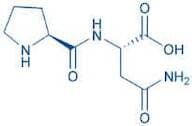
CAS 107856-82-6
:L-Asparagine, L-prolyl-
Description:
L-Asparagine, L-prolyl- is a dipeptide composed of the amino acids L-asparagine and L-proline. It is characterized by its structure, which includes an amide group from asparagine and a cyclic structure from proline, contributing to its unique properties. This compound is typically soluble in water due to the presence of polar functional groups, which allows it to interact favorably with aqueous environments. L-Asparagine plays a crucial role in protein synthesis and metabolism, while proline is known for its role in stabilizing protein structures. The dipeptide may exhibit specific biological activities, including potential roles in cellular signaling and metabolic pathways. Additionally, it may be involved in various biochemical processes, making it of interest in both nutritional and pharmaceutical contexts. As with many peptides, its stability can be influenced by factors such as pH and temperature, which can affect its conformation and reactivity. Overall, L-Asparagine, L-prolyl- serves as an important compound in biochemistry and molecular biology.
Formula:C9H15N3O4
Sort by
Purity (%)
0
100
|
0
|
50
|
90
|
95
|
100
Found 2 products.
H-Pro-Asn-OH
CAS:Bachem ID: 4008296.
Formula:C9H15N3O4Purity:> 99%Color and Shape:White PowderMolecular weight:229.24H-Pro-Asn-OH
CAS:H-Pro-Asn-OH is a reactive functional group that is activated by the presence of acidic conditions. It can react with epoxides to form cyclic ethers. H-Pro-Asn-OH can be used in vitro studies to assess the activation of caspases, which are proteolytic enzymes that play a role in cell apoptosis. It has also been used for molecular imaging and as an antigen for immunotherapy in cancer treatment. This molecule has a reactive functional group on its side chain and reacts with epoxides to form cyclic ethers.Formula:C9H15N3O4Purity:Min. 95%Molecular weight:229.23 g/mol