CAS 108171-26-2
:CHLOROPARAFFIN
Description:
Chloroparaffins are a group of synthetic organic compounds derived from the chlorination of paraffins, which are saturated hydrocarbons. The specific substance with the CAS number 108171-26-2 is a chlorinated alkane that typically consists of a mixture of chlorinated n-alkanes. These compounds are characterized by their high chlorine content, which imparts properties such as flame retardancy and chemical stability. Chloroparaffins are generally colorless, odorless liquids or solids, depending on their molecular weight and degree of chlorination. They are insoluble in water but soluble in organic solvents. Due to their chemical structure, chloroparaffins exhibit low volatility and are resistant to degradation, making them useful in various applications, including plasticizers, lubricants, and flame retardants in plastics and rubber. However, concerns regarding their environmental impact and potential toxicity have led to increased scrutiny and regulation of their use in many regions. Proper handling and disposal are essential to mitigate any associated risks.
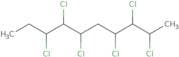
Formula:C10H16Cl6
InChI:InChI=1/C10H16Cl6/c1-3-6(12)10(16)8(14)4-7(13)9(15)5(2)11/h5-10H,3-4H2,1-2H3
SMILES:CCC(C(C(CC(C(C(C)Cl)Cl)Cl)Cl)Cl)Cl
Synonyms:- 2,3,4,6,7,8-Hexachlorodecane
- Alkanes, C10-12, chloro
- Alkanes, C<sub>10-12</sub>, chloro
- C<sub>10-12</sub> alkanes, chloro
- C<sub>10-12</sub> chloroalkane
- C<sub>10-12</sub> chloroalkanes
- Chlorinated paraffins (average chain length C12, approximately 60% by weight chlorine)
- Chlorinatedalkanesc10-12
- Chlorinatedparaffins(C12,60%Chlorine)
- Chloroalkanes, C<sub>10-12</sub>
- Paraffinwaxesandhydrocarbonwaxes,Chlorinated(C12,60%Chlorine)
- CHLOROPARAFFIN
- See more synonyms
Sort by
Purity (%)
0
100
|
0
|
50
|
90
|
95
|
100
Found 2 products.
Chloroparaffin
CAS:Controlled ProductChloroparaffin is a chemical with the chemical formula CCl. It is an organochlorine compound that has been used as a cross-linking agent, reaction solution, and as a cell for chemical structures. Chloroparaffin has been used in the synthesis of hydroxybenzoic acid, boron nitride, and diphenyl ether. It also reacts with copper to produce copper complexes. Chloroparaffin has shown to be effective in the detection of hydroxyl groups in organic compounds, which are important in many biological processes. Chloroparaffin can be used in magnetic resonance spectroscopy because it absorbs at high frequencies and can be detected by optical sensors.Purity:Min. 95%Color and Shape:PowderRef: 4Z-D-167010
Discontinued product