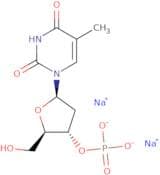
CAS 108320-91-8
:thymidine 3'-monophosphate disodium
Description:
Thymidine 3'-monophosphate disodium, also known as dTMP or thymidine monophosphate, is a nucleotide that plays a crucial role in the synthesis of DNA. It is a derivative of thymidine, which is one of the four nucleosides that make up DNA. The disodium salt form indicates that the compound contains two sodium ions, which enhance its solubility in aqueous solutions. Thymidine 3'-monophosphate is characterized by its phosphate group attached to the 3' carbon of the ribose sugar, which is essential for the formation of nucleic acid polymers. This compound is involved in various biochemical processes, including DNA replication and repair, and serves as a building block for the synthesis of DNA. In laboratory settings, it is often used in molecular biology applications, such as PCR and DNA sequencing. Its stability and solubility make it a valuable reagent in research and therapeutic contexts. As with many nucleotides, it is sensitive to hydrolysis and should be stored under appropriate conditions to maintain its integrity.
Formula:C10H14N2NaO8P
InChI:InChI=1/C10H15N2O8P.Na/c1-5-3-12(10(15)11-9(5)14)8-2-6(7(4-13)19-8)20-21(16,17)18;/h3,6-8,13H,2,4H2,1H3,(H,11,14,15)(H2,16,17,18);
SMILES:Cc1cn(C2CC(C(CO)O2)OP(=O)(O)O)c(=O)nc1O.[Na]
Synonyms:- 2,4(1H,3H)-pyrimidinedione, 1-(2-deoxy-3-O-phosphonopentofuranosyl)-5-methyl-, monosodium salt
- Thymidine 3'-Monophosphate Sodium Salt
- 2'-Deoxythymidine-3'-monophosphate,Disodium salt
- thymidine 3'-monophosphate disodium
- THYMIDINE 3-MONOPHOSPHATE SODIUM
- 2'-deoxy-3'-TMP·Na2
- 3'-Thymidylic acid,sodium salt (9CI)
Sort by
Purity (%)
0
100
|
0
|
50
|
90
|
95
|
100
Found 1 products.
Thymidine 3'-monophosphate sodium salt
CAS:Thymidine 3'-monophosphate sodium salt (TMP) is a nucleoside that is involved in the synthesis of DNA. TMP has been shown to have minimal carcinogenic effects on the liver, with no effect on the rate of DNA synthesis or cell proliferation in vivo. It has been shown to be hepatotoxic and genotoxic in animal studies and can cause DNA strand breaks and chromosomal aberrations in liver cells. TMP also causes a specific adduct, crotonaldehyde, which is considered to be an indicator of hepatic injury. The detection method for this adduct uses gas chromatography-mass spectrometry, which identifies the presence of TMP by detecting its unique mass spectrum.Formula:C10H15N2O8P•xNaPurity:Min. 95%Color and Shape:Powder