CAS 1086696-26-5
:Ascaroside C3
Description:
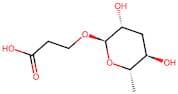
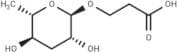
Ascaroside C3, identified by its CAS number 1086696-26-5, is a chemical compound belonging to the class of ascarosides, which are glycosides derived from ascaroside, a type of sugar molecule. This compound is notable for its role in the signaling processes of nematodes, particularly in the context of their development and behavior. Ascaroside C3 is characterized by its unique structure, which typically includes a sugar moiety linked to a fatty acid or other hydrophobic tail, contributing to its biological activity. It is often studied for its potential applications in pest control and as a biochemical tool in research related to nematode biology. The compound is generally soluble in organic solvents and may exhibit varying degrees of stability depending on environmental conditions. Its specific interactions and effects on biological systems make it a subject of interest in both chemical and biological research fields.
Formula:C9H16O6
InChI:InChI=1S/C9H16O6/c1-5-6(10)4-7(11)9(15-5)14-3-2-8(12)13/h5-7,9-11H,2-4H2,1H3,(H,12,13)/t5-,6+,7+,9+/m0/s1
InChI key:InChIKey=RYYMJVGKZLQYPG-YYWONIAYSA-N
SMILES:O(CCC(O)=O)[C@H]1[C@H](O)C[C@@H](O)[C@H](C)O1
Synonyms:- 3-[(3,6-Dideoxy-α-L-arabino-hexopyranosyl)oxy]propanoic acid
- Propanoic acid, 3-[(3,6-dideoxy-α-L-arabino-hexopyranosyl)oxy]-
- Ascaroside C3
Sort by
Purity (%)
0
100
|
0
|
50
|
90
|
95
|
100
Found 3 products.
Ascr#5
CAS:Ascr#5 (asc-ωC3) is a highly conserved ascoside analogue in Cryptococcus hidradii that modulates a variety of responses in Cryptococcus hidradii.Formula:C9H16O6Purity:≥98% - ≥98%Color and Shape:SolidMolecular weight:220.22Ascaroside C3
CAS:Ascaroside C3 is a peptide that is derived from the ascaroside family of proteins. Ascarosides are natural products found in the seed coat of the plant Ascaris coarctata. The protein interactions, receptor binding, and ion channel blocking properties of ascarosides have been studied extensively. This peptide has high purity, and is used as a research tool in cell biology and cell-based assays. It can also be used as an antibody or ligand to study protein interactions, receptor binding, and ion channel blocking properties.Formula:C9H16O6Purity:Min. 95%Molecular weight:220.22 g/mol