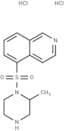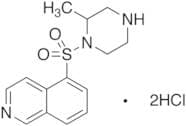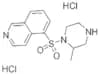
CAS 108930-17-2
:H 7 dihydrochloride
Description:
H7 dihydrochloride, with the CAS number 108930-17-2, is a chemical compound that typically exhibits characteristics associated with its molecular structure and functional groups. As a dihydrochloride salt, it is likely to be a stable, crystalline solid at room temperature, soluble in water and other polar solvents due to the presence of chloride ions. The compound may exhibit basic properties, as it is derived from a base that has been protonated by hydrochloric acid. Its molecular interactions can include hydrogen bonding, which may influence its solubility and reactivity. H7 dihydrochloride may be utilized in various applications, including pharmaceutical formulations, where it could serve as an active ingredient or a stabilizing agent. Safety data sheets would typically indicate handling precautions, as with many chemical substances, to mitigate risks associated with exposure. Overall, the specific characteristics of H7 dihydrochloride would depend on its precise molecular structure and the context of its use.
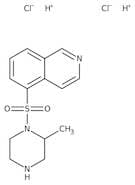
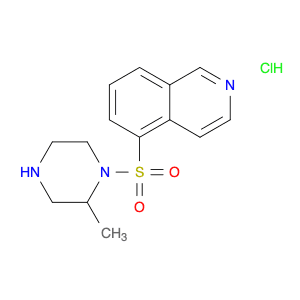
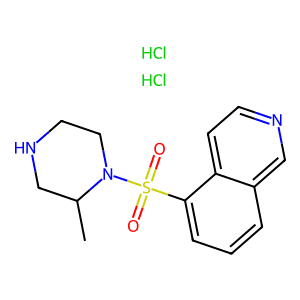
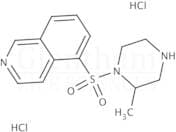
Formula:C14H17N3O2S·2ClH
InChI:InChI=1S/C14H17N3O2S.2ClH/c1-11-9-16-7-8-17(11)20(18,19)14-4-2-3-12-10-15-6-5-13(12)14;;/h2-6,10-11,16H,7-9H2,1H3;2*1H
InChI key:InChIKey=OARGPFMFRLLKPF-UHFFFAOYSA-N
SMILES:S(=O)(=O)(C=1C2=C(C=CC1)C=NC=C2)N3C(C)CNCC3.Cl
Synonyms:- (+/-)-1-(5-Isoquinolinesulfonyl)-2-Methylpiperazine 2Hcl
- (+/-)-1-(5-Isoquinolinesulfonyl)-2-Methylpiperazine Dihydrochloride
- (+/-)-1-(5-Isoquinolinesulphonyl)-2-Methylpiperazine Dihydrochloride
- (-)-1-(5-Isoquinolinesulfonyl)-2-Methylpiperazine, Di-Hcl Salt
- (3R)-4-(isoquinolin-5-ylsulfonyl)-3-methylpiperazin-1-ium
- (3S)-4-(isoquinolin-5-ylsulfonyl)-3-methylpiperazin-1-ium
- 1-(5-Isoquinolinylsulfonyl)-2-Methyl-Piperazine Dihydrochloride
- 5-[(2-Methylpiperazin-1-Yl)Sulfonyl]Isoquinoline Dihydrochloride
- 5-[(2-Methylpiperazin-1-Yl)Sulfonyl]Isoquinoline Hydrochloride
- H-7
- Isoquinoline, 5-[(2-methyl-1-piperazinyl)sulfonyl]-, hydrochloride (1:2)
- Piperazine, 1-(5-isoquinolinylsulfonyl)-2-methyl-, dihydrochloride
- See more synonyms
Sort by
Purity (%)
0
100
|
0
|
50
|
90
|
95
|
100
Found 7 products.
H-7 dihydrochloride
CAS:Protein kinase inhibitor. Inhibits cyclic nucleotide dependent protein kinase (PKA) and protein kinase C This Thermo Scientific Chemicals brand product was originally part of the Alfa Aesar product portfolio. Some documentation and label information may refer to the legacy brand. The original Alfa AFormula:C14H17N3O2S•2HClMolecular weight:364.29Protein kinase inhibitor H-7 2HCl
CAS:Formula:C14H19Cl2N3O2SPurity:98%Color and Shape:SolidMolecular weight:364.2906Protein kinase inhibitor H-7 dihydrochloride
CAS:Protein kinase inhibitor H-7 dihydrochloridePurity:≥98%Molecular weight:364.29g/molProtein kinase inhibitor H-7 dihydrochloride
CAS:Protein kinase inhibitor H-7 dihydrochloride(H-7 dihydrochloride) is a potent protein kinase C (PKC) inhibitor.Formula:C14H19Cl2N3O2SPurity:99.81%Color and Shape:White Crystalline SolidMolecular weight:364.291-(5-Isoquinolinesulfonyl)-2-methylpiperazine Dihydrochloride
CAS:Controlled ProductApplications A selective inhibitor of protein kinase C or cyclic-nucleotide-dependent protein kinases.
References Hidaka, H. and Kawamoto, S.: Biochem. and Biophys. Res. Comm., 125, 1, 258 (1984)Formula:C14H17N3O2S·2ClHColor and Shape:NeatMolecular weight:364.29H-7 dihydrochloride
CAS:H-7 is a cytostatic agent that inhibits the activation of transcription by inhibiting the synthesis of DNA and RNA. H-7 has shown to be an effective inhibitor of epidermal growth factor and α subunit, which are involved in the proliferation of cancer cells. In addition, H-7 can inhibit calcium ion influx into the cell, which may cause cell death. This drug also has potent inducers effects on primary cells, such as HL-60 cells, and induces apoptosis in carcinoma cell lines. H-7 is not an inhibitor of cyclase activity but enhances it when added with guanine nucleotide binding proteins (G proteins) activators such as forskolin. This leads to increased levels of cyclic AMP. As a result, H-7 inhibits protein synthesis and activates cytosolic calcium channels.Formula:C14H17N3O2S·2HClPurity:Min. 95%Molecular weight:364.29 g/mol