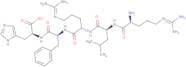
CAS 109024-47-7
:b-Bag Cell Peptide (Aplysia californica)
Description:
b-Bag Cell Peptide, derived from the marine mollusk Aplysia californica, is a neuropeptide that plays a significant role in the modulation of neural activity and behavior. This peptide is part of a larger family of neuropeptides involved in various physiological processes, including stress response and reproductive behaviors. Characteristically, b-Bag Cell Peptide exhibits a relatively small molecular size and is composed of a specific sequence of amino acids that contribute to its biological activity. It functions primarily as a signaling molecule, influencing neuronal excitability and synaptic transmission. The peptide is known for its role in the activation of bag cells, which are clusters of neurosecretory cells that release hormones affecting reproductive functions. Its structure and function are of interest in neurobiology and pharmacology, as understanding its mechanisms can provide insights into similar processes in other organisms. Research on b-Bag Cell Peptide continues to explore its potential applications in neuroscience and therapeutic interventions.
Formula:C33H53N13O6
Synonyms:- Beta-Bag Cell Peptide (Aplysia californica) trifluoroacetate salt
- β-Bag Cell Peptide (Aplysia californica) trifluoroacetate salt
- b-Bag Cell Peptide (Aplysia californica)
- L-Histidine, L-arginyl-L-leucyl-L-arginyl-L-phenylalanyl-
- β-Bag Cell Peptide (Aplysia californica)
Sort by
Purity (%)
0
100
|
0
|
50
|
90
|
95
|
100
Found 1 products.
Beta-Bag Cell Peptide (Aplysia californica) trifluoroacetate salt
CAS:Aplysia californica is a species of sea slug that produces a peptide, beta-Bag Cell Peptide (BACP), which has been shown to have depolarizing effects on neurons. BACP can be synthesized from the amino acid sequence of the Aplysia californica cell membrane protein, and this synthetic peptide has been shown to have maximal depolarizing effects at high concentrations. The depolarizing effect of BACP can be seen in populations of neurons as well as individual neurons. This peptide also desensitizes autoreceptors for acetylcholine and serotonin, which may play a role in its electrophysiological effects.Formula:C33H53N13O6Purity:Min. 95%Molecular weight:727.86 g/mol