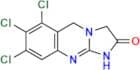
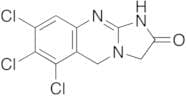
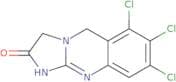
![6,7,8-Trichloro-1,5-dihydroimidazo[2,1-b]quinazolin-2(3H)-one](/_next/image/?url=https%3A%2Fstatic.cymitquimica.com%2Fcas-image%2Fthumb-webp%2F295640-678-trichloro-15-dihydroimidazo-21-b-quinazolin-2-3h-one.webp&w=3840&q=75)
CAS 1092352-99-2
:6,7,8-Trichloro-1,5-dihydroimidazo[2,1-b]quinazolin-2(3H)-one
Description:
6,7,8-Trichloro-1,5-dihydroimidazo[2,1-b]quinazolin-2(3H)-one is a heterocyclic compound characterized by its complex structure, which includes a fused imidazole and quinazoline ring system. This compound features three chlorine substituents at the 6, 7, and 8 positions, contributing to its unique chemical reactivity and potential biological activity. The presence of the imidazo and quinazolinone moieties suggests that it may exhibit interesting pharmacological properties, possibly acting as an inhibitor or modulator in various biochemical pathways. Its molecular structure allows for potential interactions with biological targets, making it a candidate for further research in medicinal chemistry. Additionally, the chlorine atoms can influence the compound's lipophilicity and solubility, which are critical factors in drug design. As with many halogenated compounds, it may also exhibit specific environmental and toxicological considerations that warrant careful handling and assessment in both laboratory and industrial settings.
Formula:C10H6Cl3N3O
InChI:InChI=1S/C10H6Cl3N3O/c11-5-1-6-4(8(12)9(5)13)2-16-3-7(17)15-10(16)14-6/h1H,2-3H2,(H,14,15,17)
InChI key:InChIKey=QCMDDIIKBFVZSY-UHFFFAOYSA-N
SMILES:ClC1=C2C(NC=3N(C2)CC(=O)N3)=CC(Cl)=C1Cl
Synonyms:- Imidazo[2,1-b]quinazolin-2(3H)-one, 6,7,8-trichloro-1,5-dihydro-
- 6,7,8-Trichloro-1,5-dihydroimidazo[2,1-b]quinazolin-2(3H)-one
Sort by
Purity (%)
0
100
|
0
|
50
|
90
|
95
|
100
Found 4 products.
8-Chloro Anagrelide
CAS:Controlled ProductApplications 8-Chloro Anagrelide is an impurity of Anagrelide (A637300).
Formula:C10H6Cl3N3OColor and Shape:NeatMolecular weight:290.538-Chloro anagrelide
CAS:8-Chloro anagrelide (8CA) is a synthetic chemical that is used in the preparation of isatins. It has been shown to react with chlorinating agents and produce cyanogen chloride, which can be used in the synthesis of other compounds. 8CA has been synthesized at constant temperature and high yield by treating N-benzoyl-4-chloroaniline with phosphorus pentachloride and ethyl bromoacetate. The reaction mechanism for this process includes alkylation, reduction, and oxidation reactions.Formula:C10H6Cl3N3OPurity:Min. 95%Molecular weight:290.53 g/mol