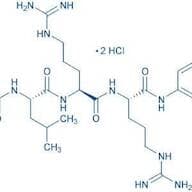
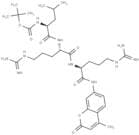
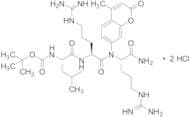
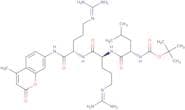
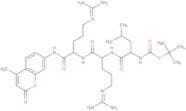
CAS 109358-46-5
:Boc-Leu-Arg-Arg-AMC . 2 HCl
Description:
Boc-Leu-Arg-Arg-AMC·2 HCl, also known as a peptide substrate, is a synthetic compound commonly used in biochemical research, particularly in studies involving proteases and enzyme activity. The "Boc" (tert-butyloxycarbonyl) group serves as a protective group for the amino acid leucine (Leu), while "Arg" denotes arginine residues, which are known for their basic properties and involvement in various biological processes. The "AMC" (7-amino-4-methylcoumarin) moiety acts as a fluorescent reporter, allowing for the detection of enzymatic cleavage. The presence of two hydrochloride (HCl) salts indicates that the compound is in a salt form, which can enhance its solubility in aqueous solutions. This compound is typically utilized in assays to monitor proteolytic activity, as the cleavage of the peptide bond releases the fluorescent AMC, enabling quantitative analysis. Its stability, solubility, and fluorescent properties make it a valuable tool in molecular biology and biochemistry for studying enzyme kinetics and substrate specificity.
Sort by
Purity (%)
0
100
|
0
|
50
|
90
|
95
|
100
Found 6 products.
Boc-Leu-Arg-Arg-AMC · 2 HCl
CAS:Boc-LLR-AMC is a good substrate for the Kex2 endoprotease (kexin, previously known as proteinase yscF), a membrane-bound, calcium-dependent serine protease from yeast α-cells. Boc-LRR-AMC is also used for determining the trypsin-like activity of the proteasome.Formula:C33H52N10O7·2HClPurity:> 99%Color and Shape:White PowderMolecular weight:773.76Boc-LRR-AMC
CAS:Boc-LRR-AMC is a fluorogenic 26S/20S proteasome substrate that releases fluorescent AMC upon cleavage, aiding activity quantification.Formula:C33H52N10O7Color and Shape:SolidMolecular weight:700.83Boc-Leu-Arg-Arg-AMC
CAS:Formula:C33H52N10O7·C2H4O2Purity:≥ 98.0%Color and Shape:White lyophilised powderMolecular weight:760.9Boc-Leu-Arg-Arg-AMC·2 HCl
CAS:Controlled ProductFormula:C33H52N10O7Color and Shape:NeatMolecular weight:700.829Boc-Leu-Arg-Arg-AMC dihydrochloride
CAS:Boc-Leu-Arg-Arg-AMC·2 HCl is a soybean trypsin inhibitor that has been used in the study of basic protein synthesis and cellular physiology. This inhibitor binds to the active site of soybean trypsin, preventing it from cleaving peptide bonds. The kinetic of this reaction was studied using Boc-Leu-Arg-Arg-AMC·2 HCl as a substrate and its inhibition by various concentrations of inhibitors. The inhibitory effect on the enzyme activity was measured by following the release of AMC fluorogenic substrate in vitro. Boc-Leu-Arg-Arg-AMC·2 HCl was found to be an effective inhibitor of melanoma antigen formation in vivo when injected into mice with melanoma xenografts. It also decreased tumor growth and increased survival rates in leukemic mice treated with platinum chemotherapy drugs or other pharmacological agents.Formula:C33H52N10O7·2HClPurity:Min. 95%Molecular weight:773.75 g/molBoc-Leu-Arg-Arg-AMC
CAS:Boc-Leu-Arg-Arg-AMC is a synthetic, nonpeptide antagonist of the CGRP receptor. It has been shown to inhibit the binding of peptides to the CGRP receptor and is used as a research tool for studying the pharmacology and protein interactions of this receptor. Boc-Leu-Arg-Arg-AMC has been shown to stimulate ion channel activity in vitro. This compound also has an affinity for antibodies that are specific for CGRP receptors, which can be used as a ligand in immunoassays.Formula:C33H52N10O7Purity:Min. 95%Molecular weight:700.83 g/mol