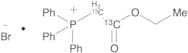
CAS 109376-35-4
:(carbethoxymethyl-1,2-13C2)triphenyl-phosphonium
Formula:C2013C2H23BrO2P
InChI:InChI=1/C22H22O2P.BrH/c1-2-24-22(23)18-25(19-12-6-3-7-13-19,20-14-8-4-9-15-20)21-16-10-5-11-17-21;/h3-17H,2,18H2,1H3;1H/q+1;/i18+1,22+1;
Synonyms:- (Carbethoxymethyl-1,2-13C2)triphenylphosphonium bromide
- phosphonium, (2-ethoxy-2-oxoethyl-1,2-13C2)triphenyl-, hydrobromide
Sort by
The purity filter is not visible because current products do not have associated purity data for filtering.
Found 1 products.
(Ethoxycarbonylmethyl)triphenylphosphonium-13C2 Bromide
CAS:Controlled ProductApplications (Ethoxycarbonylmethyl)triphenylphosphonium-13C2 bromide is an intermediate in the synthesis of 3-Chloro-4-(dichloromethyl)-5-hydroxy-2(5H)-furanone-13C5, which is an isotope labelled Mutagen X (MX) is a chlorinated furanone that accounts for more of the mutagenic activity of drinking water than any other disinfection byproduct. DNA damages provoked by the six mutagens (furylframide, MX, 4-nitroquinoline N-oxide, sodium azide, 1-nitropyrene, and captan) used in the present study have been known to subject to the nucleotide excision repair system.
References Hakulinen, P., et al.: Toxicol. Lett., 151, 439 (2004), Richardson, S., et al.: Mutat. Res., 636, 178 (2007), Kim, J., et al.: Environ. Toxicol., 23, 319 (2008),Formula:C2013C2H22BrO2PColor and Shape:NeatMolecular weight:431.27