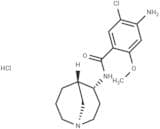
CAS 109872-41-5
:Renzapride hydrochloride
Description:
Renzapride hydrochloride is a chemical compound primarily recognized for its pharmacological properties, particularly as a gastroprokinetic agent. It acts as a selective serotonin 5-HT4 receptor agonist, which enhances gastrointestinal motility, making it useful in treating conditions like functional dyspepsia and constipation-predominant irritable bowel syndrome. The compound is typically presented as a hydrochloride salt, which improves its solubility and stability in aqueous solutions. Renzapride exhibits a moderate affinity for 5-HT3 receptors, which may contribute to its antiemetic effects. Its chemical structure includes a piperidine ring, which is common in many pharmacologically active compounds. The substance is generally administered orally and is characterized by its relatively low toxicity profile. However, like many medications, it may have side effects, including gastrointestinal disturbances or central nervous system effects. Overall, Renzapride hydrochloride represents a significant advancement in the management of gastrointestinal disorders, reflecting the ongoing research into serotonin receptor modulation for therapeutic purposes.
Formula:C16H22ClN3O2
InChI:InChI=1/C16H22ClN3O2/c1-22-15-8-13(18)12(17)7-11(15)16(21)19-14-4-6-20-5-2-3-10(14)9-20/h7-8,10,14H,2-6,9,18H2,1H3,(H,19,21)/t10-,14+/m0/s1
Synonyms:- 4-amino-N-1-azabicyclo[3.3.1]non-4-yl-5-chloro-2-methoxybenzamide hydrochloride
Sort by
Purity (%)
0
100
|
0
|
50
|
90
|
95
|
100
Found 2 products.
Renzapride hydrochloride
CAS:Renzapride is a 5-HT3 antagonist and 5-HT4 agonist. Renzapride also functions as a 5-HT2B antagonist and has some affinity for the 5-HT2A and 5-HT2C receptors.Formula:C16H23Cl2N3O2Color and Shape:SolidMolecular weight:360.28Renzapride hydrochloride
CAS:Renzapride is a drug which is used for the treatment of gastrointestinal disorders. It belongs to a class of drugs called D2 receptor antagonists. Renzapride inhibits the activity of ion channels, which are protein structures that permit the flow of ions across cell membranes. The use of renzapride has been shown to activate dopamine receptors in the brain and inhibit serotonin receptors in the hypothalamus, which may be responsible for its pharmacological effects. Renzapride has also been shown to bind to peptides and antibodies and can be used as a research tool to study protein interactions and antibody-antigen reactions.Formula:C16H23Cl2N3O2Purity:Min. 95%Molecular weight:360.3 g/mol