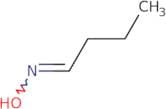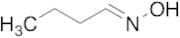
CAS 110-69-0
:Butanal, oxime
Description:
Butanal oxime, with the CAS number 110-69-0, is an organic compound characterized by its oxime functional group attached to a butanal backbone. It appears as a colorless to pale yellow liquid with a distinctive odor. The molecular formula is C4H9NO, indicating the presence of four carbon atoms, nine hydrogen atoms, one nitrogen atom, and one oxygen atom. Butanal oxime is known for its ability to participate in various chemical reactions, including condensation and rearrangement, making it useful in organic synthesis. It is soluble in water and organic solvents, which enhances its applicability in different chemical processes. This compound is often utilized in the production of pharmaceuticals, agrochemicals, and as an intermediate in the synthesis of other organic compounds. However, it is essential to handle butanal oxime with care, as it may pose health risks upon exposure, necessitating appropriate safety measures during its use and storage.
Formula:C4H9NO
InChI:InChI=1S/C4H9NO/c1-2-3-4-5-6/h4,6H,2-3H2,1H3
InChI key:InChIKey=KGGVGTQEGGOZRN-UHFFFAOYSA-N
SMILES:C(C=NO)CC
Synonyms:- (1E)-butanal oxime
- (1Z)-butanal oxime
- Butanal oxime
- Butanaldoxime
- Butylaldoxime
- Butyraldehyde oxime
- Butyraldoxime
- N-hydroxybutan-1-imine
- NSC 1487
- n-Butylaldoxime
- n-Butyraldoxime
Sort by
Purity (%)
0
100
|
0
|
50
|
90
|
95
|
100
Found 5 products.
Butyraldoxime
CAS:Formula:C4H9NOPurity:>95.0%(GC)Color and Shape:Colorless to Almost colorless clear liquidMolecular weight:87.12Butyraldoxime
CAS:Butyraldoxime is a chemical that is used in the treatment of skin cancer. It has been shown to inhibit the growth of cultured human cells, including melanoma cells and leukemia cells. In vitro tests have shown that butyraldoxime inhibits sodium citrate-induced changes in cell morphology, an increase in cellular protein content and DNA synthesis, and an increase in tumor size. The mechanism of action for butyraldoxime is thought to be similar to that of the oxime inhibitor drugs. Oximes react with nitrite ion to form a reactive intermediate called nitrous acid, which reacts with caproic acid to form a nitric oxide radical. Nitric oxide radicals are then able to react with free methyl ethyl groups on the surface of cells and produce reactive oxygen species (ROS). ROS can cause damage to cell membranes, proteins and DNA within the cell. This damage may lead to cell death or inhibition of cellular function.Formula:C4H9NOPurity:Min. 95%Molecular weight:87.12 g/molButyraldoxime
CAS:Formula:C4H9NOPurity:98.0%Color and Shape:Liquid, No data available.Molecular weight:87.122Butyraldoxime
CAS:Controlled ProductApplications Butyraldoxime (cas# 110-69-0) is a useful research chemical.
Formula:C4H9NOColor and Shape:NeatMolecular weight:87.12