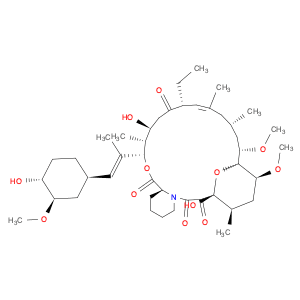
CAS 11011-38-4
:Ascomycin
Description:
Ascomycin, with the CAS number 11011-38-4, is a macrolide antibiotic that is derived from the fermentation of certain species of fungi, particularly those in the genus *Aspergillus*. It exhibits a broad spectrum of antifungal activity, primarily targeting various fungal infections, and is particularly effective against *Candida* species and certain molds. Ascomycin functions by inhibiting the synthesis of fungal cell walls and interfering with protein synthesis, which ultimately leads to cell death. This compound is characterized by its complex molecular structure, which includes a large lactone ring and multiple hydroxyl groups, contributing to its biological activity. Ascomycin is also known for its immunosuppressive properties, making it of interest in the field of transplantation medicine. Its solubility in organic solvents and limited solubility in water are notable physical properties. Due to its potent effects and specific mechanisms of action, ascomycin is utilized in both clinical and research settings, although its use may be limited by potential side effects and resistance development in certain pathogens.
Formula:C43H69NO12
InChI:InChI=1/C43H67NO12/c1-10-30-18-24(2)17-25(3)19-36(53-8)39-37(54-9)21-27(5)43(51,56-39)40(48)41(49)44-16-12-11-13-31(44)42(50)55-38(28(6)33(46)23-34(30)47)26(4)20-29-14-15-32(45)35(22-29)52-7/h18,20,25,27-32,35-39,45,51H,10-17,19,21-23H2,1-9H3/b24-18-,26-20+/t25-,27-,28-,29+,30-,31+,32-,35-,36+,37+,38-,39-,43-/m1/s1
InChI key:InChIKey=ZDQSOHOQTUFQEM-NURRSENYSA-N
SMILES:O(C)[C@@H]1[C@@]2(O[C@](O)([C@H](C)C1)C(=O)C(=O)N3[C@](C(=O)O[C@H](\C(=C\[C@H]4C[C@@H](OC)[C@H](O)CC4)\C)[C@H](C)[C@@H](O)CC(=O)[C@H](CC)/C=C(\C)/C[C@H](C)C[C@@H]2OC)(CCCC3)[H])[H]
Synonyms:- (3S,4R,5S,8R,12S,14R,15R,16S,18R,19R,26aS)-8-ethyl-5,19-dihydroxy-3-{(E)-2-[(1S,3R,4S)-4-hydroxy-3-methoxycyclohexyl]-1-methylethenyl}-14,16-dimethoxy-4,10,12,18-tetramethyl-5,6,8,11,12,13,14,15,16,17,18,19,24,25,26,26a-hexadecahydro-3H-15,19-epoxypyrido[2,1-c][1,4]oxazacyclotricosine-1,7,20,21(4H,23H)-tetrone
- (3S,4R,5S,8R,12S,14S,15R,16S,18R,19R,26aS)-8-ethyl-5,19-dihydroxy-3-{(E)-2-[(1R,3R,4R)-4-hydroxy-3-methoxycyclohexyl]-1-methylethenyl}-14,16-dimethoxy-4,10,12,18-tetramethyl-5,6,8,11,12,13,14,15,16,17,18,19,24,25,26,26a-hexadecahydro-3H-15,19-epoxypyrido[2,1-c][1,4]oxazacyclotricosine-1,7,20,21(4H,23H)-tetrone
- (3S,4R,5S,8R,9E,12S,14S,15R,16S,18R,19R,26aS)-8-Ethyl-5,6,8,11,12,13,14,15,16,17,18,19,24,25,26,26a-hexadecahydro-5,19-dihydroxy-3-[(1E)-2-[(1R,3R,4R)-4-hydroxy-3-methoxycyclohexyl]-1-methylethenyl]-14,16-dimethoxy-4,10,12,18-tetramethyl-15,19-epoxy-3H-pyrido[2,1-c][1,4]oxaazacyclotricosine-1,7,20,21(4H,23H)-tetrone
- (3S,4S,5S,8R,12S,14S,15R,16S,18R,19R,26aS)-8-ethyl-5,19-dihydroxy-3-{(E)-2-[(1R,3R,4R)-4-hydroxy-3-methoxycyclohexyl]-1-methylethenyl}-14,16-dimethoxy-4,10,12,18-tetramethyl-5,6,8,11,12,13,14,15,16,17,18,19,24,25,26,26a-hexadecahydro-3H-15,19-epoxypyrido[2,1-c][1,4]oxazacyclotricosine-1,7,20,21(4H,23H)-tetrone
- 12,18-Tetramethyl-,(3S-(3R*(E(1S*,3S*,4S*)),4S*,19S*,26Ar*))--10
- 15,19-Epoxy-3H-pyrido[2,1-c][1,4]oxaazacyclotricosine-1,7,20,21(4H,23H)-tetrone, 8-ethyl-5,6,8,11,12,13,14,15,16,17,18,19,24,25,26,26a-hexadecahydro-5,19-dihydroxy-3-[(1E)-2-[(1R,3R,4R)-4-hydroxy-3-methoxycyclohexyl]-1-methylethenyl]-14,16-dimethoxy-4,10,12,18-tetramethyl-, (3S,4R,5S,8R,9E,12S,14S,15R,16S,18R,19R,26aS)-
- 15,19-Epoxy-3H-pyrido[2,1-c][1,4]oxaazacyclotricosine-1,7,20,21(4H,23H)-tetrone, 8-ethyl-5,6,8,11,12,13,14,15,16,17,18,19,24,25,26,26a-hexadecahydro-5,19-dihydroxy-3-[2-(4-hydroxy-3-methoxycyclohexyl)-1-methylethenyl]-14,16-dimethoxy-4,10,12,18-tetramethyl-, [3S-[3R*[E(1S*,3S*,4S*)],4S*,5R*,8S*,9E,12R*,14R*,15S*,16R*,18S*,19S*,26aR*]]-
- 8-Ethyl-3-(2-(4-Hydroxy-3-Methoxycyclohexyl)-1-Methylethenyl)-14,16-Dimethoxy
- AAG
- Ascomycin, Streptomyces Hygroscopicus
- Ascomycin, Streptomyces Hygroscopicus Var Ascomyceticus
- Changchuanmycin
- Fk-520
- Fr 520
- Fr-900520
- Immunomycin
- L 683590
- Ascomycin, >=98.5%
- Nsc106410
- nitrogen permease regulator-like 3 (S. cerevisiae)
- Ascomycin
- CGTHBA
- Ascomycin 1
- RP23-177M10.6
- CS-740
- Ascomycin (Immunomycin,FK-520)
- Ascomycin, Streptomyces hygroscopicus - CAS 11011-38-4 - Calbiochem
- Ascomycin (FK520)
- Aids093221
- Ascomycin (Immunomycin
- Aids-093221
- Anti-Nprl3 antibody produced in goat
- See more synonyms
Sort by
Purity (%)
0
100
|
0
|
50
|
90
|
95
|
100
Found 2 products.
(3S,4R,5S,8R,9E,12S,14S,15R,16S,18R,19R,26aS)-8-Ethyl-5,6,8,11,12,13,14,15,16,17,18,19,24,25,26,26a-hexadecahydro-5,19-dihydroxy-3-[(1E)-2-[(1R,3R,4R)-4-hydroxy-3-methoxycyclohexyl]-1-methylethenyl]-14,16-dimethoxy-4,10,12,18-tetramethyl-15,19-epoxy-3H-pyrido[2,1-c][1,4]oxaazacyclotricosine-1,7,20,21(4H,23H)-tetrone
CAS:Formula:C43H69NO12Purity:95%Color and Shape:SolidMolecular weight:792.0075Ascomycin
CAS:Ascomycin is an immunosuppressant macrolide lactone, which is derived from the soil bacterium *Streptomyces hygroscopicus*. It functions primarily by inhibiting the T-cell activation pathway. The mechanism involves binding to the immunophilin FKBP-12, forming a complex that inhibits the calcium-dependent phosphatase, calcineurin. This inhibition prevents the dephosphorylation and subsequent translocation of nuclear factor of activated T cells (NFAT), which is crucial for the transcription of interleukin-2 and other cytokines. Consequently, this suppresses the activation and proliferation of T-cells, which are essential components of the adaptive immune response.Formula:C43H69NO12Purity:Min. 95%Molecular weight:792.01 g/mol