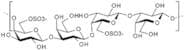
CAS 11016-36-7
:porphyran
Description:
Porphyran is a sulfated polysaccharide primarily derived from certain species of red algae, particularly those in the genus Porphyra. It is characterized by its complex structure, which includes a backbone of repeating disaccharide units, typically composed of galactose and 3,6-anhydrogalactose, along with sulfate groups that contribute to its solubility and biological activity. Porphyran exhibits gelling properties, making it useful as a thickening agent in food and cosmetic applications. Additionally, it has garnered attention for its potential health benefits, including antioxidant, anti-inflammatory, and immunomodulatory effects. The substance is also studied for its role in drug delivery systems and as a source of dietary fiber. Porphyran is generally recognized as safe for consumption, but its specific properties can vary depending on the source and extraction methods used. Its unique characteristics make it a valuable compound in both industrial and biomedical fields.
- Porphyran
Sort by
Purity (%)
0
100
|
0
|
50
|
90
|
95
|
100
Found 1 products.
Porphyran
CAS:Porphyran is an agar-like polysaccharide with a linear backbone consisting of 3 linked β-D-galactosyl units alternating with either 4-linked α-L-galactosyl 6-sulphate or 3-6-anhydro-α-L-galactosyl units.The composition includes 6-O-sulphated L-galactose, 6-O-methylated D-galactose, L-galactose, 3,6-anhydro-L-galactose, 6-O-methyl D-galactose and ester sulphate. Some of the ester is present as 1,4-linked L-galactose 6-sulphate. The precise composition of porphyran shows seasonal and environmental variations. Porphyran is not used commercially, but the seaweed, Porphyra umbilicalis, is edible and is consumed in Wales (Laver). It is also made into a delicacy called Laverbread. The image was kindly provided by Prof Mike Guiry from Cork who runs ‘The Seaweed Site’.Purity:(%) Min. 80%Color and Shape:Powder