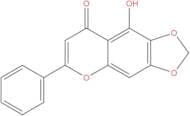
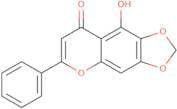
![9-Hydroxy-6-phenyl-8H-1,3-dioxolo[4,5-g][1]benzopyran-8-one](/_next/image/?url=https%3A%2Fstatic.cymitquimica.com%2Fcas-image%2Fthumb-webp%2F315817-9-hydroxy-6-phenyl-8h-13-dioxolo-45-g-1-benzopyran-8-one.webp&w=3840&q=75)
CAS 110204-45-0
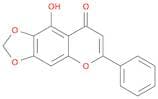
:9-Hydroxy-6-phenyl-8H-1,3-dioxolo[4,5-g][1]benzopyran-8-one
Description:
9-Hydroxy-6-phenyl-8H-1,3-dioxolo[4,5-g][1]benzopyran-8-one, with the CAS number 110204-45-0, is a synthetic organic compound that belongs to the class of flavonoids, specifically a benzopyran derivative. This compound features a complex polycyclic structure characterized by a benzopyran core fused with a dioxole ring and a phenyl substituent. Its molecular structure contributes to its potential biological activities, including antioxidant and anti-inflammatory properties. The presence of hydroxyl groups enhances its reactivity and solubility in polar solvents. This compound may exhibit fluorescence, making it of interest in various applications, including photochemistry and as a potential fluorescent probe. Additionally, its unique structure may allow for interactions with biological macromolecules, suggesting potential therapeutic applications. However, detailed studies on its pharmacological properties and mechanisms of action are necessary to fully understand its utility in medicinal chemistry. As with many synthetic compounds, safety and toxicity assessments are crucial for any practical applications.
Formula:C16H10O5
InChI:InChI=1S/C16H10O5/c17-10-6-11(9-4-2-1-3-5-9)21-12-7-13-16(20-8-19-13)15(18)14(10)12/h1-7,18H,8H2
InChI key:InChIKey=NJIUXIXNVAHRDW-UHFFFAOYSA-N
SMILES:OC=1C2=C(OC(=CC2=O)C3=CC=CC=C3)C=C4C1OCO4
Synonyms:- 5-Hydroxy-6,7-methylenedioxyflavone
- 9-Hydroxy-6-phenyl-8H-1,3-dioxolo[4,5-g][1]benzopyran-8-one
- Cochliophilin A
- 8H-1,3-Dioxolo[4,5-g][1]benzopyran-8-one, 9-hydroxy-6-phenyl-
Sort by
Purity (%)
0
100
|
0
|
50
|
90
|
95
|
100
Found 4 products.
5-HYDROXY-6,7-METHYLENEDIOXYFLAVONE
CAS:Formula:C16H10O5Purity:97%Color and Shape:SolidMolecular weight:282.24769-Hydroxy-6-phenyl-8H-[1,3]dioxolo[4,5-g]chromen-8-one
CAS:9-Hydroxy-6-phenyl-8H-[1,3]dioxolo[4,5-g]chromen-8-onePurity:97%Molecular weight:282.25g/molCochliophilin A
CAS:Cochliophilin A is a specialized secondary metabolite, which is isolated from certain fungal species, notably of the genus *Cochliobolus*. This compound is known for its role as a self-germination and tropic factor, meaning it can influence both the germination and directional growth of fungal spores. The mechanism of action involves its binding to specific receptors on the spore surface, triggering intracellular pathways that promote germination under suitable environmental conditions. Furthermore, it can induce directed growth responses, facilitating interactions between fungi and host organisms in nature.Formula:C16H10O5Purity:Min. 95%Color and Shape:PowderMolecular weight:282.25 g/mol

![9-Hydroxy-6-phenyl-8H-[1,3]dioxolo[4,5-g]chromen-8-one](/_next/image/?url=https%3A%2Fstatic.cymitquimica.com%2Fproducts%2F54%2Fthumb%2FOR1058620.jpg&w=3840&q=75)