CAS 110216-87-0
:4-AMINOQUINOLINE-2-ONE
Description:
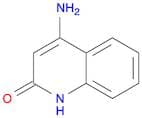
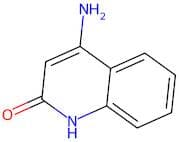
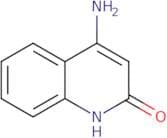
4-Aminoquinoline-2-one is an organic compound characterized by its quinoline structure, which consists of a fused benzene and pyridine ring. This compound features an amino group (-NH2) at the 4-position and a carbonyl group (C=O) at the 2-position of the quinoline ring. It is typically a crystalline solid and may exhibit properties such as solubility in polar solvents, which is common for compounds containing amino and carbonyl functional groups. The presence of the amino group can impart basicity, while the carbonyl group can participate in hydrogen bonding and other interactions. 4-Aminoquinoline-2-one is of interest in medicinal chemistry due to its potential biological activities, including antimalarial and antimicrobial properties. Its structure allows for various chemical modifications, which can enhance its pharmacological profile. As with many quinoline derivatives, it may also exhibit fluorescence, making it useful in certain analytical applications. Safety and handling precautions should be observed, as with all chemical substances, due to potential toxicity or reactivity.
Formula:C9H8N2O
InChI:InChI=1/C9H8N2O/c10-7-5-9(12)11-8-4-2-1-3-6(7)8/h1-5H,(H3,10,11,12)
SMILES:c1ccc2c(c1)c(cc(n2)O)N
Synonyms:- Aurora Ka-3886
- 4-aminoquinolin-2(1H)-one
- Zinc02550723
- 4-AMINOQUINOLINE-2-ONE
- 2(1H)-Quinolinone, 4-amino-
- 4-Amino-2(1H)-quinolinone
Sort by
Purity (%)
0
100
|
0
|
50
|
90
|
95
|
100
Found 4 products.
4-Aminoquinoline-2-one
CAS:4-Aminoquinoline-2-one is a nonsteroidal anti-inflammatory drug that has tuberculostatic activity. It binds to the nitrogen atoms of the enzyme dihydropteroate synthase, which is involved in the synthesis of folic acid and DNA. This leads to an increase in reactive oxygen species and inflammation, which causes disease activity. 4-Aminoquinoline-2-one has been shown to be synergistic with monoclonal antibodies when used as a treatment for inflammatory diseases. In order for 4-aminoquinoline-2-one to be taken up by cells, it must bind to cellular uptake proteins through hydrogen bonds or disulfide bonds.
Formula:C9H8N2OPurity:Min. 95%Molecular weight:160.17 g/mol