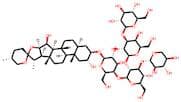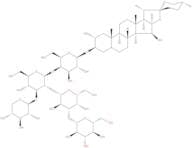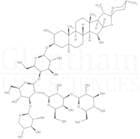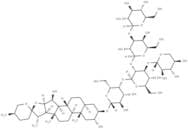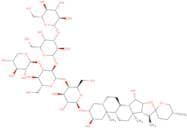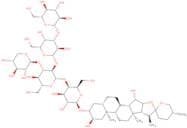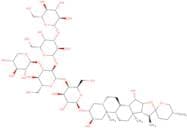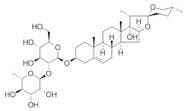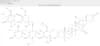
CAS 11024-24-1
:Digitonin
Description:
Digitonin is a glycoside derived from the plant Digitalis purpurea, commonly known as foxglove. It is primarily used in biochemistry and pharmacology for its ability to selectively solubilize membrane proteins, making it valuable in the study of cellular membranes and their components. Digitonin has a complex structure, featuring a steroid backbone linked to a sugar moiety, which contributes to its amphipathic nature. This property allows it to interact with lipid bilayers, facilitating the extraction of membrane proteins while maintaining their functional integrity. In addition to its biochemical applications, digitonin exhibits cytotoxic effects on certain cell types, which has implications for its use in research and potential therapeutic contexts. It is important to handle digitonin with care, as it can be toxic in higher concentrations. Overall, digitonin serves as a crucial tool in the study of membrane biology and the isolation of membrane-associated proteins.
Formula:C56H92O29
InChI:InChI=1S/C56H92O29/c1-19-7-10-56(75-17-19)20(2)31-45(85-56)37(67)32-22-6-5-21-11-26(24(61)12-55(21,4)23(22)8-9-54(31,32)3)76-50-42(72)39(69)44(30(16-60)80-50)81-53-48(47(36(66)29(15-59)79-53)83-49-40(70)33(63)25(62)18-74-49)84-52-43(73)46(35(65)28(14-58)78-52)82-51-41(71)38(68)34(64)27(13-57)77-51/h19-53,57-73H,5-18H2,1-4H3/t19-,20+,21+,22-,23+,24-,25-,26-,27-,28-,29-,30-,31+,32-,33+,34-,35+,36-,37+,38+,39-,40-,41-,42-,43-,44+,45-,46+,47+,48-,49+,50-,51+,52+,53+,54-,55+,56-/m1/s1
InChI key:InChIKey=UVYVLBIGDKGWPX-KUAJCENISA-N
SMILES:C[C@@]12[C@@]3([C@]([C@@H](O)[C@]1([C@]4([C@](CC2)([C@]5(C)[C@@](CC4)(C[C@@H](O[C@@H]6O[C@H](CO)[C@H](O[C@H]7[C@H](O[C@H]8[C@H](O)[C@@H](O[C@@H]9O[C@H](CO)[C@@H](O)[C@H](O)[C@H]9O)[C@@H](O)[C@@H](CO)O8)[C@@H](O[C@H]%10[C@H](O)[C@@H](O)[C@H](O)CO%10)[C@H](O)[C@@H](CO)O7)[C@H](O)[C@H]6O)[C@H](O)C5)[H])[H])[H])[H])(O[C@@]%11([C@H]3C)CC[C@@H](C)CO%11)[H])[H]
Synonyms:- (2alpha,3beta,5alpha,15beta,25R)-2,15-dihydroxyspirostan-3-yl beta-D-glucopyranosyl-(1->3)-beta-D-galactopyranosyl-(1->2)-[beta-D-xylopyranosyl-(1->3)]-(4xi)-beta-D-xylo-hexopyranosyl-(1->4)-beta-D-galactopyranoside
- (2alpha,3beta,5alpha,15beta,25R)-spirostan-2,3,15-triol
- (2α,3β,5α,15β,25R)-2,15-Dihydroxyspirostan-3-yl O-β-<span class="text-smallcaps">D</smallcap>-glucopyranosyl-(1→3)-O-β-<smallcap>D</smallcap>-galactopyranosyl-(1→2)-O-[β-<smallcap>D</smallcap>-xylopyranosyl-(1→3)]-O-β-<smallcap>D</smallcap>-glucopyranosyl-(1→4)-β-<smallcap>D</span>-galactopyranoside
- Ai3-44893
- Brn 0078654
- Digitin
- Digitogenin, 3-[O-β-<span class="text-smallcaps">D</smallcap>-glucopyranosyl-(1→3)-O-β-<smallcap>D</smallcap>-galactopyranosyl-(1→2)-O-[β-<smallcap>D</smallcap>-xylopyranosyl-(1→3)]-O-β-<smallcap>D</smallcap>-glucopyranosyl-(1→4)-β-<smallcap>D</span>-galactopyranoside]
- Digitogenin, 3-[O-β-D-glucopyranosyl-(1→3)-O-β-D-galactopyranosyl-(1→2)-O-[β-D-xylopyranosyl-(1→3)]-O-β-D-glucopyranosyl-(1→4)-β-D-galactopyranoside]
- Digitogenin, glycoside
- Digitonina
- Digitonine
- Nsc 23471
- Nsc 237417
- Spiro[8H-naphth[2′,1′:4,5]indeno[2,1-b]furan-8,2′-[2H]pyran], β-<span class="text-smallcaps">D</span>-galactopyranoside deriv.
- Spirostan, β-<span class="text-smallcaps">D</span>-galactopyranoside deriv.
- beta-D-Galactopyranoside, (2alpha,3beta,5alpha,15beta,25R)-2,15-dihydroxyspirostan-3-yl O-beta-D-glucopyranosyl-(1-3)-O-beta-D-galactopyranosyl-(1-2)-O-(beta-D-xylopyranosyl-(1-3))-O-beta-D-glucopyranosyl-(1-4)-
- beta-D-Galactopyranoside, (2alpha,3beta,5alpha,15beta,25R)-2,15-dihydroxyspirostan-3-yl O-beta-D-glucopyranosyl-(1.fwdarw.3)-O-beta-D-galactopyranosyl-(1.fwdarw.2)-O-(beta-D-xylopyranosyl-(1.fwdarw.3))-O-beta-D-glucopyranosyl-(1.fwdarw.4)-
- β-<span class="text-smallcaps">D</smallcap>-Galactopyranoside, (2α,3β,5α,15β,25R)-2,15-dihydroxyspirostan-3-yl O-β-<smallcap>D</smallcap>-glucopyranosyl-(1→3)-O-β-<smallcap>D</smallcap>-galactopyranosyl-(1→2)-O-[β-<smallcap>D</smallcap>-xylopyranosyl-(1→3)]-O-β-<smallcap>D</span>-glucopyranosyl-(1→4)-
- β-D-Galactopyranoside, (2α,3β,5α,15β,25R)-2,15-dihydroxyspirostan-3-yl O-β-D-glucopyranosyl-(1→3)-O-β-D-galactopyranosyl-(1→2)-O-[β-D-xylopyranosyl-(1→3)]-O-β-D-glucopyranosyl-(1→4)-
- Digitonin
- Spirostan, β-D-galactopyranoside deriv.
- See more synonyms
Sort by
Purity (%)
0
100
|
0
|
50
|
90
|
95
|
100
Found 11 products.
Digitonin
CAS:Formula:C56H92O29Color and Shape:White to Light yellow powder to crystalineMolecular weight:1,229.32Digitonin
CAS:DigitoninFormula:C56H92O29Color and Shape: white to yellowish powderMolecular weight:1,229.31g/molDigitonin
CAS:Formula:C56H92O29Color and Shape:White to pale yellow crystalline powderMolecular weight:1229.31Digitonin
CAS:Digitonin is a natural product of the glycoside family and is a detergent.Formula:C56H92O29Color and Shape:Physical Description Crystals Or White Powder (Ntp 1992)Molecular weight:1229.31Digitonin Glycosides
CAS:Controlled ProductFormula:C56H92O29Color and Shape:White SolidMolecular weight:1229.31Digitonin, stable clear, water-soluble
CAS:This Digitonin product (stable clear, water soluble) is a superior water soluble Digitonin with improved stability for aqueous solutions. Digitonin is produced from seeds of Digitalis pupurea and other Digitalis species. It is a steroid glycoside consisting of the aglycone digitogenin linked to five sugar residues. Digitonin has hemolytic activity and is toxic to humans. Digitonin is frequently used for the solubilization of membrane proteins and for the permeabilization of cellular and nuclear membranes. It permeabilizes plasma membranes of eukaryotic cells by complexing with membrane cholesterol and other unconjugated β-hydroxysterols. This mechanism is used in procedures for the determination of cholesterol and ergosterol using Digitonin. About this product: Aqueous solutions of conventional Digitonin will precipitate upon cooling to 4°C and will lose most of the biochemical function. Therefore, the precipitate is usually removed by filtration in many protocols. This filtration however decreases the concentration of Digitonin and alters the solubilizing power of the original product. In addition, precipitation and subsequent filtration result in an unknown Digitonin concentration in the final solutions and may negatively affect the reproducibility of any experiment with such solutions. In contrast to conventional Digitonin, our product Digitonin, stable clear, water soluble is a special grade that will not precipitate for at least one week.Formula:C56H92O29Molecular weight:1,229.34 g/molDigitonin - water-insoluble
CAS:Digitonin is produced from seeds of Digitalis pupurea and other Digitalis species. It is a steroid glycoside consisting of the aglycone digitogenin linked to five sugar residues. Reaction of naturally occurring steroids carrying a 3b-hydroxyl group with digitonin results in an insoluble precipitate. Digitonin has hemolytic activity and is toxic to humans. It permeabilizes plasma membranes of eukaryotic cells by complexing with membrane cholesterol and other unconjugated β-hydroxysterols. Digitonin is frequently used for solubilization of membrane proteins and permeabilization of cellular and nuclear membranes. Due to the complexing interactions it can be used for the determination of cholesterol and ergosterol This Digitonin product is insoluble in water.Formula:C56H92O29Color and Shape:PowderMolecular weight:1,229.34 g/molDigitonin, water-insoluble
CAS:Digitonin is produced from seeds of Digitalis pupurea and other Digitalis species. It is a steroid glycoside consisting of the aglycone digitogenin linked to five sugar residues. Reaction of naturally occurring steroids carrying a 3b-hydroxyl group with digitonin results in an insoluble precipitate. Digitonin has hemolytic activity and is toxic to humans. It permeabilizes plasma membranes of eukaryotic cells by complexing with membrane cholesterol and other unconjugated β-hydroxysterols. Digitonin is frequently used for solubilization of membrane proteins and permeabilization of cellular and nuclear membranes. Due to the complexing interactions it can be used for the determination of cholesterol and ergosterol.Formula:C56H92O29Molecular weight:1,229.34 g/molDigitonin, water-soluble
CAS:Digitonin is produced from seeds of Digitalis pupurea and other Digitalis species. It is a steroid glycoside consisting of the aglycone digitogenin linked to five sugar residues. Reaction of naturally occurring steroids carrying a 3b-hydroxyl group with digitonin results in an insoluble precipitate. Digitonin has hemolytic activity and is toxic to humans. It permeabilizes plasma membranes of eukaryotic cells by complexing with membrane cholesterol and other unconjugated beta-hydroxysterols. Digitonin is frequently used for solubilization of membrane proteins and permeabilization of cellular and nuclear membranes. Due to the complexing interactions it can be used for the determination of cholesterol and ergosterol.
Formula:C56H92O29Molecular weight:1,229.34 g/molDigitonin (Digitin) extrapure, 50%
CAS:Formula:C56H92O29Color and Shape:White, Crystalline powder, Clear, ColourlessMolecular weight:1229.30