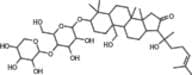
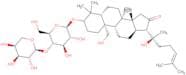
CAS 11028-00-5
:BACOSIDE A
Description:
Bacoside A is a natural compound primarily derived from the Bacopa monnieri plant, commonly known for its use in traditional medicine and as a nootropic. It is classified as a triterpenoid saponin and is known for its potential neuroprotective and cognitive-enhancing properties. Bacoside A is believed to facilitate synaptic transmission and promote the growth of nerve endings, which may contribute to improved memory and learning capabilities. The compound exhibits antioxidant properties, helping to mitigate oxidative stress in neural tissues. Additionally, Bacoside A has been studied for its potential effects on anxiety and depression, showcasing its role in promoting mental well-being. Its solubility in water is limited, which can affect its bioavailability, but various formulations are being explored to enhance its absorption. Overall, Bacoside A is recognized for its therapeutic potential, particularly in the context of cognitive health and neuroprotection, making it a subject of interest in both pharmacological research and herbal medicine.
Formula:C41H68O13
InChI:InChI=1/C41H68O13/c1-21(2)9-8-14-40(7,50)29-22-10-11-27-38(5,39(22,6)17-23(29)44)15-12-26-37(3,4)28(13-16-41(26,27)20-43)53-36-33(49)31(47)34(25(18-42)52-36)54-35-32(48)30(46)24(45)19-51-35/h9,22,24-36,42-43,45-50H,8,10-20H2,1-7H3/t22-,24+,25-,26+,27+,28?,29-,30+,31-,32-,33-,34-,35+,36+,38-,39-,40+,41-/m1/s1
Synonyms:- (5R,8R,9S,10S,13R,14R,17S)-3-[(2R,3R,4R,5S,6R)-3,4-dihydroxy-6-(hydroxymethyl)-5-[(2S,3R,4S,5S)-3,4,5-trihydroxytetrahydropyran-2-yl]oxy-tetrahydropyran-2-yl]oxy-17-[(1S)-1-hydroxy-1,5-dimethyl-hex-4-enyl]-10-(hydroxymethyl)-4,4,8,14-tetramethyl-1,2,3,5,6,7,9,11,12,13,15,17-dodecahydrocyclopenta[a]phenanthren-16-one
- 3-[(O-α-<span class="text-smallcaps">L</smallcap>-Arabinopyranosyl-β-<smallcap>D</span>-glucopyranosyl)oxy]-19,20-dihydroxydammar-24-en-16-one
- Dammar-24-en-16-one, 3-[(O-α-<span class="text-smallcaps">L</smallcap>-arabinopyranosyl-β-<smallcap>D</span>-glucopyranosyl)oxy]-19,20-dihydroxy-
- Dammar-24-en-16-one, 3-[(α-<span class="text-smallcaps">L</smallcap>-arabinopyranosyl-O-β-<smallcap>D</span>-glucopyranosyl)oxy]-19,20-dihydroxy-
- 3-[(O-α-L-Arabinopyranosyl-β-D-glucopyranosyl)oxy]-19,20-dihydroxydammar-24-en-16-one
- Dammar-24-en-16-one, 3-[(O-α-L-arabinopyranosyl-β-D-glucopyranosyl)oxy]-19,20-dihydroxy-
- Bacoside A
- Dammar-24-en-16-one, 3-[(α-L-arabinopyranosyl-O-β-D-glucopyranosyl)oxy]-19,20-dihydroxy-
- -D-glucopyranosyl)oxy]-19,- 20-dihydroxy-
- Dammar-24-en-16-one,3-[(O-R-Larabinopyranosyl- â
- 3-[(O-alpha-L-Arabinopyranosyl-beta-D-glucopyranosyl)oxy]-19,20-dihydroxydammar-24-en-16-one
- See more synonyms
Sort by
Purity (%)
0
100
|
0
|
50
|
90
|
95
|
100
Found 4 products.
Bacoside A
CAS:Bacoside A shows potential anti-cancer effects, cytoprotection, EAE inhibition, and vasorelaxation abilities.Formula:C41H68O13Purity:98%Color and Shape:SolidMolecular weight:768.98Stevenleaf
CAS:Stevenleaf is a natural compound that has been shown to have antioxidant, anti-inflammatory and neuroprotective properties. It has been found to reduce neuronal death in an experimental model of malignant brain tumor. Stevenleaf also has the ability to inhibit mitochondrial membrane potential and mitochondrial functions, which may be due to its ability to inhibit the activity of cytochrome c oxidase. It is unclear how this compound works in humans, but it may be due to its ability to alter nuclear DNA transcription or by binding with human serum proteins. Stevenleaf may have therapeutic effects against neurodegenerative diseases such as Parkinson's disease and Alzheimer's disease due to its ability to increase the efficiency of mitochondria and prevent cellular damage caused by oxidative stress. The optimum concentration for this compound is not yet known, but it has been shown that at high concentrations it can cause cytotoxicity.Purity:90%Min