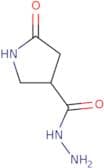
CAS 1105193-37-0
:5-Oxo-3-pyrrolidinecarboxylic acid hydrazide
Description:
5-Oxo-3-pyrrolidinecarboxylic acid hydrazide is a chemical compound characterized by its unique structure, which includes a pyrrolidine ring and a hydrazide functional group. This compound typically exhibits properties associated with both hydrazides and pyrrolidine derivatives, such as potential reactivity in condensation reactions and the ability to form hydrogen bonds due to the presence of the hydrazide moiety. It may display moderate solubility in polar solvents, influenced by the functional groups present. The compound's structure suggests potential biological activity, making it of interest in medicinal chemistry and drug development. Additionally, its synthesis may involve the reaction of pyrrolidine derivatives with hydrazine or hydrazine derivatives, leading to various applications in organic synthesis and pharmaceutical research. As with many chemical substances, safety data and handling precautions should be considered, particularly regarding its reactivity and potential toxicity. Further studies would be necessary to fully elucidate its properties and potential applications in various fields.
Formula:C5H9N3O2
InChI:InChI=1S/C5H9N3O2/c6-8-5(10)3-1-4(9)7-2-3/h3H,1-2,6H2,(H,7,9)(H,8,10)
InChI key:InChIKey=YBFBICBMBQEKSM-UHFFFAOYSA-N
SMILES:C(NN)(=O)C1CC(=O)NC1
Synonyms:- 5-Oxo-3-pyrrolidinecarboxylic acid hydrazide
- 3-Pyrrolidinecarboxylic acid, 5-oxo-, hydrazide
Sort by
Purity (%)
0
100
|
0
|
50
|
90
|
95
|
100
Found 1 products.
5-Oxopyrrolidine-3-carbohydrazide
CAS:<p>5-Oxopyrrolidine-3-carbohydrazide (OPC) is a synthetic molecule that has been shown to exhibit significant antifungal activity in vitro. This compound was also found to have cytotoxic activity in vitro, which may be due to its ability to inhibit the growth of cancer cells. OPC is an antimicrobial agent and exhibits significant antibacterial and anticancer activities. It has a pharmacophore that consists of a chlorine atom linked to three benzene rings and two hydrazine groups. This molecular structure allows it to bind to chloride ions, making it an effective agent against bacteria and fungi. OPC may be a potential anticancer agent because of its cytotoxic activity on several types of cancer cells in vitro.</p>Formula:C5H9N3O2Purity:Min. 95%Molecular weight:143.14 g/mol