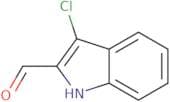
CAS 110912-15-7
:3-chloro-1H-indole-2-carbaldehyde
Description:
3-Chloro-1H-indole-2-carbaldehyde is an organic compound characterized by its indole structure, which consists of a fused benzene and pyrrole ring. The presence of a chloro group at the 3-position and an aldehyde functional group at the 2-position contributes to its reactivity and potential applications in organic synthesis. This compound is typically a solid at room temperature and may exhibit moderate solubility in organic solvents such as ethanol and dichloromethane. Its chemical properties are influenced by the electron-withdrawing nature of the chloro substituent, which can affect the reactivity of the aldehyde group. 3-Chloro-1H-indole-2-carbaldehyde is of interest in medicinal chemistry and material science, as it can serve as a building block for the synthesis of various biologically active compounds. Additionally, its unique structure may impart specific optical or electronic properties, making it suitable for research in fields such as fluorescence and photochemistry. Safety precautions should be taken when handling this compound, as it may pose health risks.
Formula:C9H6ClNO
InChI:InChI=1/C9H6ClNO/c10-9-6-3-1-2-4-7(6)11-8(9)5-12/h1-5,11H
SMILES:c1ccc2c(c1)c(c(C=O)[nH]2)Cl
Synonyms:- 1H-Indole-2-carboxaldehyde, 3-chloro-
- 3-Chloro-1H-indole-2-carbaldehyde
Sort by
Purity (%)
0
100
|
0
|
50
|
90
|
95
|
100
Found 2 products.
3-Chloro-1 H -indole-2-carbaldehyde
CAS:Formula:C9H6ClNOPurity:95.0%Color and Shape:SolidMolecular weight:179.63-Chloro-1H-indole-2-carbaldehyde
CAS:3-Chloro-1H-indole-2-carbaldehyde is a bifunctional reagent that can be used to form amides. It reacts with primary and secondary amines, as well as dialkyl and methylene amines, to produce the corresponding chloro-, phenylhydrazine-, or nitrosoaminoureas. This reaction is intramolecular and yields the desired product in high yield. The reactant can also be used as a chloride source. 3-Chloro-1H-indole-2-carbaldehyde is manufactured by reacting phenylhydrazine with chloroacetic acid in an organic solvent at room temperature (25°C).
Formula:C9H6ClNOPurity:Min. 95%Molecular weight:179.6 g/mol