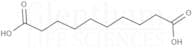
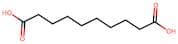
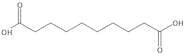
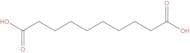
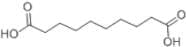
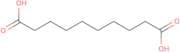
CAS 111-20-6
:Sebacic acid
Description:
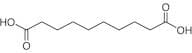
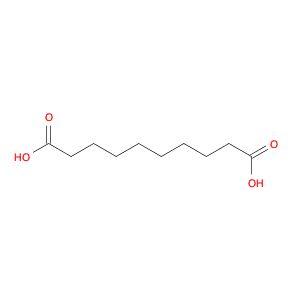
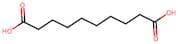
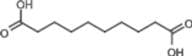
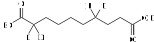
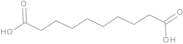
Sebacic acid, with the CAS number 111-20-6, is a dicarboxylic acid characterized by its linear chain structure consisting of ten carbon atoms. It appears as a white, crystalline solid at room temperature and has a melting point that typically falls within a moderate range. Sebacic acid is soluble in organic solvents such as ethanol and ether but has limited solubility in water. It is known for its fatty acid properties and is derived from castor oil through a process of hydrolysis and subsequent oxidation. This compound is widely used in the production of polyamides, lubricants, and plasticizers, as well as in the synthesis of various esters for cosmetic and pharmaceutical applications. Additionally, sebacic acid serves as a biodegradable alternative in various industrial applications, aligning with increasing environmental sustainability efforts. Its chemical formula is C10H18O4, and it exhibits properties typical of carboxylic acids, including the ability to form salts and esters.
Formula:C10H18O4
InChI:InChI=1S/C10H18O4/c11-9(12)7-5-3-1-2-4-6-8-10(13)14/h1-8H2,(H,11,12)(H,13,14)
InChI key:InChIKey=CXMXRPHRNRROMY-UHFFFAOYSA-N
SMILES:C(CC(O)=O)CCCCCCC(O)=O
Synonyms:- 1,10-Decanedioic acid
- 1,8-Octanedicarboxylic Acid
- Acide sebacique
- Acido Sebacico
- Nsc 19492
- Nsc 97405
- Sebacic Acid
- Sebacinsaeure
- Sebacinsaure
- n-Decanedioic acid
- Decanedioic acid
- Octane-1,8-dicarboxylic acid
- decanedioate
- See more synonyms
Sort by
Purity (%)
0
100
|
0
|
50
|
90
|
95
|
100
Found 15 products.
Sebacic Acid
CAS:Formula:C10H18O4Purity:>98.0%(GC)(T)Color and Shape:White powder to lumpMolecular weight:202.25Sebacic acid, 98+%
CAS:Sebacic acid is used as a monomer for nylon 610, plasticizers, lubricants, hydraulic fluids, cosmetics and candles. It is also used as intermediates in antiseptics, aromatics and painting materials. It is used in the synthesis of poly(glycerol sebacate) and novel bio-nylon. It finds application asFormula:C10H18O4Purity:98+%Color and Shape:White to pale cream, Crystals or powder or crystalline powder or granules or prills or beadsMolecular weight:202.251,8-Octanedicarboxylic Acid
CAS:Formula:C10H18O4Purity:95%Color and Shape:SolidMolecular weight:202.2475Sebacic acid
CAS:Formula:C10H18O4Purity:≥ 98.0%Color and Shape:White to off-white powderMolecular weight:202.25Decanedioic acid
CAS:Formula:C10H18O4Purity:95%Color and Shape:Crystalline Powder,LumpsMolecular weight:202.25Decanedioic acid
CAS:Decanedioic acid (Sebacinsaure) is a saturated, straight-chain naturally occurring dicarboxylic acid.Formula:C10H18O4Purity:99.73%Color and Shape:Reacts Violently With Bases And Oxidants Oxidants Solid PowderMolecular weight:202.25Sebacic Acid
CAS:Applications Sebacic Acid is a urinary metabolite that has been identified as an anti-fatigue biomarker.
References Ma, C. et. al.: J. Pharmaceut. Biomed. Anal. 105, 84 (2015)Formula:C10H18O4Color and Shape:WhiteMolecular weight:202.25Sebacic Acid pure, 98%
CAS:Formula:C10H18O4Purity:min. 98%Color and Shape:White to off-white, Crystalline powder, Clear, ColourlessMolecular weight:202.25Sebacic acid
CAS:Sebacic acid is an inorganic acid with a carboxyl group on one end and a hydroxyl group on the other. It can be found in fatty acids, which are used to make surfactants. Sebacic acid has been shown to have biological properties, such as its ability to catalyze polymerase chain reactions (PCR) and its use as a surface methodology for metals. This compound also has hydrophobic effects and can be used to separate water vapor from air. Sebacic acid is used in tissue culture because it has a redox potential that is similar to that of water, making it useful for hydroxylation reactions. Sebacic acid may also be used as a catalyst in the synthesis of zirconium oxide, which can be used in the production of ceramics and paints.Formula:C10H18O4Purity:Min. 95%Color and Shape:PowderMolecular weight:202.25 g/mol