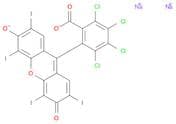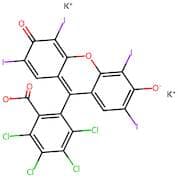
CAS 11121-48-5
:Rose Bengal
Description:
Rose Bengal is a synthetic dye belonging to the class of xanthene dyes, characterized by its vibrant pink to red color. It is commonly used in various applications, including as a biological stain in microscopy, a photosensitizer in photodynamic therapy, and as a tracer in environmental studies. The chemical structure of Rose Bengal features a dibromo derivative of fluorescein, which contributes to its strong absorbance in the visible spectrum. It is soluble in water and organic solvents, making it versatile for different experimental conditions. Rose Bengal exhibits phototoxic properties, which can be harnessed in medical applications to target and destroy cancer cells upon light activation. Additionally, it has been studied for its antioxidant properties and potential use in food and cosmetic industries. However, safety considerations are important, as it can cause skin irritation and allergic reactions in some individuals. Overall, Rose Bengal is a valuable compound in both scientific research and practical applications, with a range of characteristics that make it suitable for diverse uses.
Formula:Unspecified
InChI:InChI=1/C20H4Cl4I4O5/c21-10-8(9(20(31)32)11(22)13(24)12(10)23)7-3-1-5(25)16(29)14(27)18(3)33-19-4(7)2-6(26)17(30)15(19)28/h1-2,29H,(H,31,32)
Synonyms:- Bengal Rose
- HFinCl<sub>4</sub>I<sub>4</sub>
- Rb 1017
- Rose Bengale
- SODIUM TETRAIODODICHLOROFLUORESCEIN
- C.I. Acid Red 94
- redno.105
- Rose Bengal
- TETRACHLOROTETRAIODOFLUORESCEIN SODIUM SALT
- RB
- rose
- C.I.AcidRed94(45440)
- TETRAIODOTETRACHLOROFLUORESCEIN DISODIUM SALT
- 2,3,4,5-tetrachloro-6-(6-hydroxy-2,4,5,7-tetraiodo-3-oxo-3H-xanthen-9-yl)benzoic acid
- See more synonyms
Sort by
Purity (%)
0
100
|
0
|
50
|
90
|
95
|
100
Found 5 products.
Rose Bengal
CAS:Rose Bengal is a photosensitizer effective against microbial cells. In the presence of light and oxygen, it inhibits the growth of yeast cells and other microorganisms, sometimes leading to their death. Rose Bengal can also limit bacterial growth, restrict the colony size of filamentous fungi, and suppress the growth of "spreading fungi" such as Rhizopus and Trichoderma.Color and Shape:Solid(3-Oxo-6-Oxido-2,4,5,7-Tetraiodo-3H-Xanthen-9-Yl)-3,4,5,6-Tetrachlorobenzoate Sodium Salt
CAS:(3-Oxo-6-Oxido-2,4,5,7-Tetraiodo-3H-Xanthen-9-Yl)-3,4,5,6-Tetrachlorobenzoate Sodium SaltPurity:95%Sodium 2,3,4,5-tetrachloro-6-(2,4,5,7-tetraiodo-6-oxido-3-oxo-3H-xanthen-9-yl)benzoate
CAS:Purity:98%Molecular weight:1017.63PV-10
CAS:PV-10 is a peptide that activates ion channels. It is an agonist for the nicotinic acetylcholine receptor (nAChR) and a low-affinity antagonist for the N-methyl-D-aspartate receptor (NMDAR). PV-10 binds to specific sites on the nAChR, which causes the channel to open and allow ions to flow into the cell. This leads to depolarization of the membrane, which triggers an action potential in neurons. PV-10 is also able to bind to other proteins such as NR1 subunits of NMDARs and alpha 7 subunits of nAChRs. These interactions inhibit the function of these receptors and prevent them from opening their channels. This prevents calcium influx into cells, blocking neurotransmitter release and preventing the activation of downstream pathways that lead to neuronal death. PV-10 has been shown to be selective for certain types of ion channels over othersFormula:C20H4Cl4I4O5Purity:Min. 95%Molecular weight:973.7 g/mol