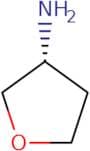
CAS 111769-26-7
:(R)-3-Aminotetrahydrofuran
Description:
(R)-3-Aminotetrahydrofuran is a chiral amine characterized by its tetrahydrofuran ring structure, which is a five-membered cyclic ether. The presence of an amino group at the 3-position of the ring imparts distinct chemical properties, making it a valuable intermediate in organic synthesis, particularly in the production of pharmaceuticals and agrochemicals. This compound is typically a colorless to pale yellow liquid or solid, depending on its purity and form. Its chirality is significant, as it can exhibit different biological activities compared to its enantiomer. (R)-3-Aminotetrahydrofuran is soluble in polar solvents, which enhances its utility in various chemical reactions. The compound can participate in nucleophilic substitutions and can be involved in the formation of more complex molecules through reactions such as acylation or alkylation. Safety data indicates that, like many amines, it should be handled with care due to potential irritant properties. Overall, (R)-3-Aminotetrahydrofuran is an important building block in synthetic organic chemistry.
Formula:C4H9NO
InChI:InChI=1/C4H9NO/c5-4-1-2-6-3-4/h4H,1-3,5H2/t4-/m1/s1
SMILES:C1COC[C@@H]1N
Synonyms:- (R)-Tetrahydrofuran-3-Amine
- R-(+)-3-Aminotetrahydofuran
- (3R)-Tetrahydrofuran-3-Amine
- (3R)-oxolan-3-amine
Sort by
Purity (%)
0
100
|
0
|
50
|
90
|
95
|
100
Found 5 products.
(R)-Tetrahydrofuran-3-amine
CAS:Formula:C4H9NOPurity:>98.0%(GC)(T)Color and Shape:Colorless to Light yellow clear liquidMolecular weight:87.12(R)-Tetrahydrofuran-3-amine
CAS:(R)-Tetrahydrofuran-3-amine
Color and Shape:LiquidMolecular weight:87.12g/mol(R)-Tetrahydrofuran-3-amine
CAS:(R)-Tetrahydrofuran-3-amine is a nucleoside phosphorylase inhibitor that binds to the catalytic site of the enzyme, inhibiting the synthesis of purine nucleotides. This drug has been shown to be effective in treating atrial fibrillation. (R)-Tetrahydrofuran-3-amine has also been used as a lead compound for the development of analogues with improved inhibitory potency and selectivity for adenosine receptors. The synthetic scheme for this compound starts by reacting 1,4-dihydropurine with aldehyde and formaldehyde under acid conditions. The product is then condensed with 2,2-dimethylpropane-1,3-dione to yield an intermediate that is oxidized and reduced to produce the final product. This process can be carried out using high performance liquid chromatography (HPLC) methods.Formula:C4H9NOPurity:Min. 95%Molecular weight:87.12 g/mol(R)-Tetrahydrofuran-3-amine
CAS:Formula:C4H9NOPurity:97%Color and Shape:LiquidMolecular weight:87.1204