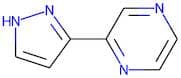
CAS 111781-54-5
:2-(1H-Pyrazol-3-yl)pyrazine
Description:
2-(1H-Pyrazol-3-yl)pyrazine is an organic compound characterized by its dual pyrazole and pyrazine functional groups, which contribute to its unique chemical properties. This compound typically appears as a solid and is known for its potential applications in medicinal chemistry and material science due to its heterocyclic structure. The presence of nitrogen atoms in both the pyrazole and pyrazine rings enhances its ability to participate in various chemical reactions, making it a versatile building block in organic synthesis. It may exhibit interesting biological activities, including antimicrobial or antitumor properties, although specific biological data would depend on further empirical studies. Additionally, its solubility and stability can vary based on the solvent and environmental conditions. Overall, 2-(1H-Pyrazol-3-yl)pyrazine is a compound of interest in research fields that explore the synthesis of novel pharmaceuticals and functional materials.
Formula:C7H6N4
InChI:InChI=1S/C7H6N4/c1-2-10-11-6(1)7-5-8-3-4-9-7/h1-5H,(H,10,11)
InChI key:InChIKey=XBSVVLLAMHTBPS-UHFFFAOYSA-N
SMILES:C=1(C=CNN1)C=2C=NC=CN2
Synonyms:- Pyrazine, 1H-pyrazol-3-yl-
- (Pyrazol-3-yl)pyrazine
- 2-(1H-Pyrazol-3-yl)pyrazine
- 2-(2H-Pyrazol-3-yl)pyrazine
- Pyrazine, 2-(1H-pyrazol-3-yl)-
Sort by
Purity (%)
0
100
|
0
|
50
|
90
|
95
|
100
Found 3 products.
2-(1H-Pyrazol-3-yl)pyrazine
CAS:2-(1H-Pyrazol-3-yl)pyrazineFormula:C7H6N4Purity:95%Color and Shape: off-white crystals/ powderMolecular weight:146.15g/mol2-(1H-Pyrazol-3-yl)pyrazine
CAS:2-(1H-Pyrazol-3-yl)pyrazine is a dinuclear compound that has been shown to inhibit the activity of anions. It has also been used in the treatment of diabetes by increasing the thermal expansion of beta cells and decreasing insulin resistance. 2-(1H-Pyrazol-3-yl)pyrazine has been shown to have magnetic properties, which can be exploited for its use in medicine. This compound is a single crystal x-ray diffraction research tool that is used to aid in understanding the structural changes that occur during thermal expansion. This compound also expands when heated, which may be due to an increase in volume or less electron density as a result of loss of hydrogens.Formula:C7H6N4Purity:Min. 95%Color and Shape:White PowderMolecular weight:146.15 g/mol2-(1H-pyrazol-3-yl)pyrazine
CAS:Formula:C7H6N4Purity:95.0%Color and Shape:Solid, Beige powderMolecular weight:146.153