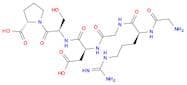
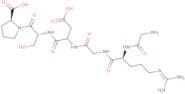
CAS 111844-24-7
:H-Gly-Arg-Gly-Asp-D-Ser-Pro-OH
Description:
The chemical substance known as H-Gly-Arg-Gly-Asp-D-Ser-Pro-OH, with the CAS number 111844-24-7, is a synthetic peptide that consists of a sequence of amino acids. This peptide features a combination of glycine (Gly), arginine (Arg), aspartic acid (Asp), D-serine (D-Ser), and proline (Pro), which are linked together in a specific order. The "H-" prefix indicates that the peptide is in its free acid form, typically denoting that it has an amine group at one end and a carboxylic acid group at the other. Peptides like this one are often studied for their biological activity, particularly in relation to cell signaling, receptor binding, and potential therapeutic applications. The presence of specific amino acids, such as arginine and aspartic acid, suggests potential interactions with cell surface receptors, making it of interest in fields like biochemistry and pharmacology. Additionally, the D-amino acid (D-Ser) in the sequence may influence the peptide's stability and bioactivity compared to its L-form counterpart.
Formula:C22H37N9O10
InChI:InChI=1/C22H37N9O10/c23-8-15(33)28-11(3-1-5-26-22(24)25)18(37)27-9-16(34)29-12(7-17(35)36)19(38)30-13(10-32)20(39)31-6-2-4-14(31)21(40)41/h11-14,32H,1-10,23H2,(H,27,37)(H,28,33)(H,29,34)(H,30,38)(H,35,36)(H,40,41)(H4,24,25,26)/t11?,12?,13-,14?/m1/s1
SMILES:C(CC(C(=NCC(=NC(CC(=O)O)C(=N[C@H](CO)C(=O)N1CCCC1C(=O)O)O)O)O)N=C(CN)O)CNC(=N)N
Synonyms:- Gly-Arg-Gly-Asp-D-Ser-Pro
- G-R-G-D-Ds-P
Sort by
Purity (%)
0
100
|
0
|
50
|
90
|
95
|
100
Found 2 products.
H-Gly-Arg-Gly-Asp-D-Ser-Pro-OH trifluoroacetate salt
CAS:H-Gly-Arg-Gly-Asp-D-Ser-Pro-OH trifluoroacetate salt (HGGDS) is a collagen gel that is used in the treatment of autoimmune diseases, such as arthritis and lupus. HGGDS inhibits the production of fibrinogen, which is a protein involved in blood clotting, by binding to its receptor on human fibroblasts. It also inhibits the production of basic proteins needed for the generation of collagen and activation of integrin receptors, which are involved in cell adhesion and migration. HGGDS also blocks transcription polymerase chain reactions (PCRs), which are necessary for the synthesis of DNA. This can lead to a decrease in cell proliferation and an increase in apoptosis.
Formula:C22H37N9O10Purity:Min. 95%Molecular weight:587.58 g/mol