CAS 111917-59-0
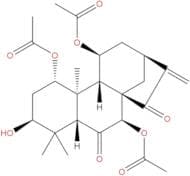
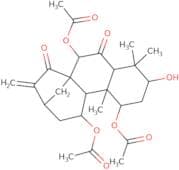
:Kaur-16-ene-6,15-dione,1,7,11-tris(acetyloxy)-3-hydroxy-, (1a,3b,7b,11b)- (9CI)
Description:
Kaur-16-ene-6,15-dione, 1,7,11-tris(acetyloxy)-3-hydroxy-, (1a,3b,7b,11b)-, commonly referred to by its CAS number 111917-59-0, is a chemical compound belonging to the class of terpenoids, specifically a type of kaurene. This compound features a complex structure characterized by multiple functional groups, including dione and hydroxy groups, as well as acetyloxy substituents. The presence of these functional groups suggests potential biological activity, which is often explored in pharmacological studies. Kaur-16-ene derivatives are known for their roles in plant physiology and may exhibit various effects, such as anti-inflammatory or anti-cancer properties. The stereochemistry indicated by the (1a,3b,7b,11b) notation suggests specific spatial arrangements of atoms, which can significantly influence the compound's reactivity and interaction with biological targets. Overall, this compound is of interest in both natural product chemistry and medicinal chemistry due to its structural complexity and potential therapeutic applications.
Formula:C26H34O9
Synonyms:- AdenanthinA
Sort by
Purity (%)
0
100
|
0
|
50
|
90
|
95
|
100
Found 5 products.
(1α,3β,7β,11β)-1,7,11-Tris(acetyloxy)-3-hydroxykaur-16-ene-6,15-dione
CAS:Formula:C26H34O9Purity:98.5%Color and Shape:SolidMolecular weight:490.5428Adenanthin
CAS:Adenanthin, a natural inhibitor of thiol-dependent antioxidant enzymes, impairs the effector functions of human natural killer cells.Formula:C26H34O9Purity:98%Color and Shape:SolidMolecular weight:490.55Adenanthin
CAS:Adenanthin is a natural diterpenoid compound, which is derived primarily from plants within the genus Isodon. This compound is obtained through the extraction and purification processes involving the aerial parts of these medicinally significant plants. Adenanthin exhibits its biological effects primarily through the modulation of oxidative stress pathways and the induction of apoptosis in certain cell lines. It specifically targets key redox-sensitive cysteine residues, thereby selectively inhibiting peroxiredoxin I and II. These actions result in the accumulation of reactive oxygen species (ROS), ultimately leading to the selective induction of apoptosis in cancerous cells, while sparing most non-cancerous cells.Formula:C26H34O9Purity:Min. 95%Molecular weight:490.6 g/molRef: 4Z-A-362001
Discontinued product