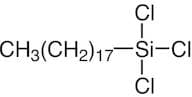
CAS 112-04-9
:Trichlorooctadecylsilane
- Ls 6495
- Nsc 96644
- OTS
- OTS (silane derivative)
- Octadecyltrichlorosilane
- Silane, Octadecyltrichloro-
- Stearyltrichlorosilane
- Trichlor(octadecyl)silan
- Trichloro(octadecyl)silane
- Trichlorooctadecylsilane
- Tricloro(Octadecil)Silano
- n-Octadecyltrichlorosilane
- See more synonyms
Trichlorooctadecylsilane
CAS:Formula:C18H37Cl3SiPurity:>85.0%(GC)Color and Shape:White or Colorless to Light yellow powder to lump to clear liquidMolecular weight:387.93Trichlorooctadecylsilane (>99.0%)
CAS:Formula:C18H37Cl3SiPurity:>99.0%(GC)Color and Shape:Colorless to Almost colorless clear liquidMolecular weight:387.93n-Octadecyltrichlorosilane, 95%, cont. 5-10% branched isomers
CAS:n-Octadecyltrichlorosilane is used in semiconductor industry to form self-assembled monolayer thin films on silicon dioxide substrates. Used in molecular electronics, as thin insulating gates in Metal-Insulator-Semiconductor Field-Effect Transistors. It is also used in platinum catalyzed synthesis.Formula:C18H37Cl3SiPurity:95%Color and Shape:Colorless to pale yellow to yellow-brown or pale brown, Clear to slightly hazy liquidMolecular weight:387.93n-OCTADECYLTRICHLOROSILANE, 97%
CAS:Alkyl Silane - Conventional Surface Bonding
Aliphatic, fluorinated aliphatic or substituted aromatic hydrocarbon substituents are the hydrophobic entities which enable silanes to induce surface hydrophobicity. The organic substitution of the silane must be non-polar. The hydrophobic effect of the organic substitution can be related to the free energy of transfer of hydrocarbon molecules from an aqueous phase to a homogeneous hydrocarbon phase. A successful hydrophobic coating must eliminate or mitigate hydrogen bonding and shield polar surfaces from interaction with water by creating a non-polar interphase. Although silane and silicone derived coatings are in general the most hydrophobic, they maintain a high degree of permeability to water vapor. This allows coatings to breathe and reduce deterioration at the coating interface associated with entrapped water. Since ions are not transported through non-polar silane and silicone coatings, they offer protection to composite structures ranging from pigmented coatings to rebar reinforced concrete. A selection guide for hydrophobic silanes can be found on pages 22-31 of the Hydrophobicity, Hydrophilicity and Silane Surface Modification brochure.
n-Octadecyltrichlorosilane; OTS; Trichlorosilyloctadecane; Trichlorooctadecylsilane
Contains <5% C18 isomersProvides lipophilic surface coatingsEmployed in patterning and printing of electroactive molecular filmsImmobilizes physiologically active cell organellesTreated substrates increase electron transport of pentacene filmsHighest concentration of terminal silane substitutionFormula:C18H37Cl3SiPurity:97% including isomersColor and Shape:Straw LiquidMolecular weight:387.93n-OCTADECYLTRICHLOROSILANE
CAS:Alkyl Silane - Conventional Surface Bonding
Aliphatic, fluorinated aliphatic or substituted aromatic hydrocarbon substituents are the hydrophobic entities which enable silanes to induce surface hydrophobicity. The organic substitution of the silane must be non-polar. The hydrophobic effect of the organic substitution can be related to the free energy of transfer of hydrocarbon molecules from an aqueous phase to a homogeneous hydrocarbon phase. A successful hydrophobic coating must eliminate or mitigate hydrogen bonding and shield polar surfaces from interaction with water by creating a non-polar interphase. Although silane and silicone derived coatings are in general the most hydrophobic, they maintain a high degree of permeability to water vapor. This allows coatings to breathe and reduce deterioration at the coating interface associated with entrapped water. Since ions are not transported through non-polar silane and silicone coatings, they offer protection to composite structures ranging from pigmented coatings to rebar reinforced concrete. A selection guide for hydrophobic silanes can be found on pages 22-31 of the Hydrophobicity, Hydrophilicity and Silane Surface Modification brochure.
n-Octadecyltrichlorosilane; OTS; Trichlorosilyloctadecane; Trichlorooctadecylsilane
Contains 5-10% C18 isomersProvides lipophilic surface coatingsEmployed in patterning and printing of electroactive molecular filmsImmobilizes physiologically active cell organellesTreated substrates increase electron transport of pentacene filmsFormula:C18H37Cl3SiPurity:97% including isomersColor and Shape:Straw LiquidMolecular weight:387.93n-Octadecyltrichlorosilane (>90%)
CAS:Controlled ProductStability Moisture Sensitive
Applications n-Octadecyltrichlorosilane (cas# 112-04-9) is a useful research chemical.
E0Formula:C18H37Cl3SiPurity:>90%Color and Shape:NeatMolecular weight:387.93n-Octadecyltrichlorosilane
CAS:S12250 - n-Octadecyltrichlorosilane
Formula:C18H37Cl3SiPurity:95%Color and Shape:Liquid, ClearMolecular weight:387.92999267578125Trichlorooctadecylsilane
CAS:Trichlorooctadecylsilane is a model system that consists of a monolayer of octadecyltrichlorosilane particles. The dispersive solid-phase extraction technique can be used to extract analytes from the surface of this particle. This technique involves removing the solvent from a sample by passing it through an adsorbent. The hydrophobic effect, which is the phenomenon that a nonpolar substance is dissolved in a nonpolar solvent, will cause analytes to bind to the hydrophobic surface of octadecyltrichlorosilane particles because they are hydrophobic.
Purity:Min. 95%