CAS 1122-98-1
:Cyclopentylacetone, Pract.
Description:
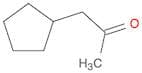
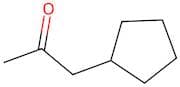
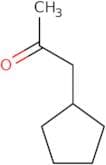
Cyclopentylacetone, also known by its CAS number 1122-98-1, is an organic compound characterized by a cyclopentyl group attached to an acetone moiety. It typically appears as a colorless to pale yellow liquid with a distinctive odor. This compound is classified as a ketone, which means it contains a carbonyl group (C=O) flanked by carbon atoms. Cyclopentylacetone is known for its relatively low volatility and moderate solubility in organic solvents, making it useful in various applications, including as a flavoring agent and in the synthesis of other organic compounds. Its chemical structure contributes to its reactivity, allowing it to participate in various chemical reactions, such as nucleophilic additions. Safety data indicates that it should be handled with care, as it may cause irritation upon contact with skin or eyes. Overall, cyclopentylacetone is a versatile compound with applications in both industrial and research settings.
Formula:C8H14O
InChI:InChI=1/C8H14O/c1-7(9)6-8-4-2-3-5-8/h8H,2-6H2,1H3
SMILES:CC(=O)CC1CCCC1
Synonyms:- 1-Cyclopentyl-2-propanone, Pract.
- Cyclopentylacetone
- 1-Cyclopentylpropan-2-One
Sort by
Purity (%)
0
100
|
0
|
50
|
90
|
95
|
100
Found 4 products.
1-Cyclopentylpropan-2-one
CAS:Cyclopentylpropan-2-one (1CPA) is an aliphatic hydrocarbon that has been shown to act as a light-sensitive molecule. It is used as a polymerization initiator and is also found in the human body as a metabolic intermediate. 1CPA is found in the form of a diacylglycerol and can be converted into an allyl carbonate, which reacts with methoxy groups to form an allyl ether. 1CPA has also been shown to have structural similarities with pyrimidine compounds and formyl groups. The 1CPA molecule contains a carbonyl group, which is the reactive functional group that allows for this chemical to react with other compounds.Formula:C8H14OPurity:Min. 95%Molecular weight:126.2 g/mol