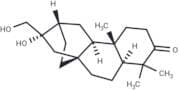
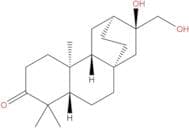
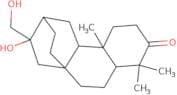
CAS 112523-91-8
:(5beta,8alpha,9beta,10alpha)-16,17-dihydroxyatisan-3-one
Description:
The chemical substance known as (5beta,8alpha,9beta,10alpha)-16,17-dihydroxyatisan-3-one, with the CAS number 112523-91-8, is a naturally occurring compound that belongs to the class of steroids. It is characterized by a complex tetracyclic structure typical of steroid compounds, featuring multiple hydroxyl (-OH) functional groups that contribute to its reactivity and biological activity. The presence of these hydroxyl groups suggests potential for hydrogen bonding, which can influence its solubility and interaction with biological macromolecules. This compound is derived from the atisan family of natural products, which are known for their diverse pharmacological properties, including anti-inflammatory and anticancer activities. Its stereochemistry, indicated by the specific alpha and beta designations, plays a crucial role in determining its biological function and interaction with receptors. Overall, (5beta,8alpha,9beta,10alpha)-16,17-dihydroxyatisan-3-one represents a significant compound in the study of natural products and their potential therapeutic applications.
Formula:C20H32O3
InChI:InChI=1/C20H32O3/c1-17(2)14-5-9-19-8-4-13(20(23,11-19)12-21)10-15(19)18(14,3)7-6-16(17)22/h13-15,21,23H,4-12H2,1-3H3/t13-,14-,15+,18-,19-,20-/m1/s1
Sort by
Purity (%)
0
100
|
0
|
50
|
90
|
95
|
100
Found 4 products.
ent-16α,17-Dihydroxyatisan-3-one
CAS:ent-16alpha,17-Dihydroxyatisan-3-one and ent-16alpha,17-dihydroxykauran-3-one have apoptosis induction activities on L5178 human MDR1 gene-transfected mouseFormula:C20H32O3Purity:98%Color and Shape:SolidMolecular weight:320.473Ent-16S,17-dihydroxyatisan-3-one
CAS:Ent-16S,17-dihydroxyatisan-3-one is a diterpenoid, which is a class of natural products characterized by a diverse range of biological activities. This compound is sourced from plants, specifically those in the Asteraceae family, where it is isolated using organic solvent extraction followed by chromatographic techniques. The mode of action involves modulation of specific cellular pathways which may include inhibiting the proliferation of cancer cells and inducing apoptosis. These actions are thought to occur through the interaction with cellular receptors or enzymes, although the exact molecular targets are still under investigation.
Formula:C20H32O3Purity:Min. 95%Molecular weight:320.5 g/molRef: 3D-MEA52391
Discontinued product