CAS 1128-53-6
:1-Phenyl-1H-pyrazol-4-amine
Description:
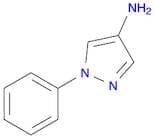
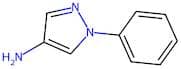
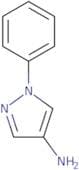
1-Phenyl-1H-pyrazol-4-amine, with the CAS number 1128-53-6, is an organic compound characterized by its pyrazole ring structure, which is a five-membered ring containing two adjacent nitrogen atoms. This compound features a phenyl group attached to the first carbon of the pyrazole ring and an amino group at the fourth position. It is typically a solid at room temperature and may exhibit various physical properties such as solubility in organic solvents. The presence of the amino group contributes to its potential as a building block in pharmaceuticals and agrochemicals, as it can participate in various chemical reactions, including nucleophilic substitutions and coupling reactions. Additionally, 1-Phenyl-1H-pyrazol-4-amine may exhibit biological activity, making it of interest in medicinal chemistry. Its reactivity and functional groups allow for modifications that can enhance its properties for specific applications. Safety data should be consulted for handling and usage, as with any chemical substance.
Formula:C9H9N3
InChI:InChI=1/C9H9N3/c10-8-6-11-12(7-8)9-4-2-1-3-5-9/h1-7H,10H2
InChI key:InChIKey=ZISOEBMQOZOEOG-UHFFFAOYSA-N
SMILES:NC1=CN(N=C1)C2=CC=CC=C2
Synonyms:- 1-Phenyl-4-pyrazoleamine
- 1-Phenylpyrazol-4-amine
- 1H-pyrazol-4-amine, 1-phenyl-
- 4-Amino-1-phenylpyrazole
- Pyrazole, 4-amino-1-phenyl-
- 1-Phenyl-1H-pyrazol-4-amine
- 4-Amino-1-phenyl-1H-pyrazole
- 1-Phenyl-1H-pyrazol-4-ylamine
Sort by
Purity (%)
0
100
|
0
|
50
|
90
|
95
|
100
Found 4 products.
1-Phenyl-1H-pyrazol-4-amine
CAS:Formula:C9H9N3Purity:98%Color and Shape:SolidMolecular weight:159.18791-Phenyl-1H-pyrazol-4-amine
CAS:1-Phenyl-1H-pyrazol-4-amine is a white crystalline solid that can be used in organic synthesis. It is soluble in water and acetone, but insoluble in ether and chloroform. The chemical formula for 1-phenyl-1H-pyrazol-4-amine is C6H5N3O. It has a molecular weight of 147.17, an empirical formula of C6H5N3O and a density of 1.47g/mL at 20°C. 1-Phenyl-1H-pyrazol-4-amine reacts with the hydroxyl group on l -glutamic acid to form the corresponding ester, which can be hydrolyzed under alkaline conditions to produce ammonia and benzoic acid. This molecule also contains an anion that can be deprotonated by an alkali metal such as sodium or potassium to form the corresponding salt, whichFormula:C9H9N3Purity:Min. 95%Molecular weight:159.19 g/mol