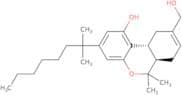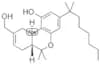
CAS 112830-95-2
:HU-210
Description:
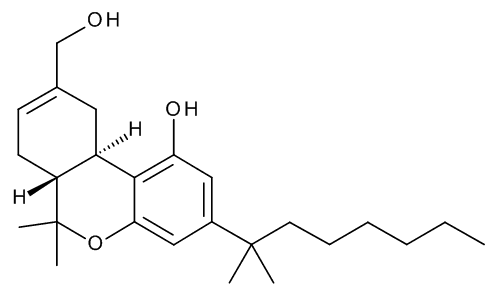
HU-210 is a synthetic cannabinoid that is structurally related to THC, the active component of cannabis. It is known for its high potency and affinity for cannabinoid receptors, particularly CB1 and CB2, which are part of the endocannabinoid system in the human body. This compound is characterized by its ability to produce effects similar to those of natural cannabinoids, including analgesia, appetite stimulation, and alterations in mood and perception. Due to its potency, HU-210 has been studied for its potential therapeutic applications, but it also raises concerns regarding safety and abuse potential. As a research chemical, it is not approved for medical use and is often associated with legal and regulatory challenges. Its stability and solubility in organic solvents make it suitable for laboratory studies, but the lack of comprehensive human studies limits the understanding of its long-term effects and safety profile. Overall, HU-210 exemplifies the complexities of synthetic cannabinoids and their implications in both research and public health.
Formula:C25H38O3
InChI:InChI=1S/C25H38O3/c1-6-7-8-9-12-24(2,3)18-14-21(27)23-19-13-17(16-26)10-11-20(19)25(4,5)28-22(23)15-18/h10,14-15,19-20,26-27H,6-9,11-13,16H2,1-5H3/t19-,20-/m1/s1
InChI key:InChIKey=SSQJFGMEZBFMNV-WOJBJXKFSA-N
SMILES:OC1=C2[C@]3([C@](C(C)(C)OC2=CC(C(CCCCCC)(C)C)=C1)(CC=C(CO)C3)[H])[H]
Synonyms:- (6AR,10aR)-3-(1,1-Dimethylheptyl)-6a,7,10,10a-tetrahydro-1-hydroxy-6,6-dimethyl-6H-dibenzo[b,d]pyran-9-methanol
- (6aR)-trans-3-(1,1-Dimethylheptyl)-6a,7,10,10a-tetrahydro-1-hydroxy-6,6-dimethyl-(6H)-dibenzo[b.d]pyran-9-methanol
- (6aR,10aR)-9-(hydroxymethyl)-6,6-dimethyl-3-(2-methyloctan-2-yl)-6a,7,10,10a-tetrahydro-6H-benzo[c]chromen-1-ol
- (6aS,10aS)-3-(1,1-dimethylheptyl)-9-(hydroxymethyl)-6,6-dimethyl-6a,7,8,10a-tetrahydrobenzo[c]isochromen-1-ol
- 6H-Dibenzo[b,d]pyran-9-methanol, 3-(1,1-dimethylheptyl)-6a,7,10,10a-tetrahydro-1-hydroxy-6,6-dimethyl-, (6aR,10aR)-
- 6H-Dibenzo[b,d]pyran-9-methanol, 3-(1,1-dimethylheptyl)-6a,7,10,10a-tetrahydro-1-hydroxy-6,6-dimethyl-, (6aR-trans)-
- HU-210 DEA Schedule I
- HU 210
- (-)-HU-210
- HU-210/112830-95-2
- HU-210 (exempt preparation)
- (-)-11-OH-Δ8-THC-1,1-dimethylheptyl
- HU-210 (solution)
- HU 210 (100μg/mL in Methanol)
- (6aR)-6aβ,7,10,10aα-Tetrahydro-6,6-dimethyl-1-hydroxy-3-(1,1-dimethylheptyl)-6H-dibenzo[b,d]pyran-9-methanol
- HU-210 (Spice Cannabinoid)
- (6aR)-6aβ,7,10,10aα-Tetrahydro-1-hydroxy-6,6-dimethyl-3-(1,1-dimethylheptyl)-6H-dibenzo[b,d]pyran-9-methanol
- 11-OH-Δ8-THC-1,1-dimethylheptyl
- See more synonyms
Sort by
Purity (%)
0
100
|
0
|
50
|
90
|
95
|
100
Found 6 products.
HU 210 (100 μg/ml in Methanol)
CAS:Controlled ProductFormula:C25H38O3Color and Shape:Single SolutionMolecular weight:386.57HU 210
CAS:Controlled ProductStability Hygroscopic
Applications A synthetic agonist analog of ∆9-Tetrahydro Cannabinol (T293200), which is the primary psychoactive component of marijuana. HU-210 is a potent central cannabinoid (CB1) and peripheral cannabinoid (CB2) receptor agonist. It binds to neuroblastoma cell membrane CB1 receptors with about the same affinity as CP-55940. Synthetic cannabinoidsControlled Substance.
References Slipetz, D.M. et al.: Mol. Pharmacol., 48, 352 (1995); Bertalovitz, A.C. et al.: Drug Dev. Res., 71, 404 (2010); Howlett, A.C. et al.: Curr. Pharm. Des., 1, 343 (1995);Formula:C25H38O3Color and Shape:Light YellowMolecular weight:386.57HU 210
CAS:Controlled ProductHU-210 is a synthetic cannabinoid receptor agonist with a strong affinity for the CB1 and CB2 receptor (Ki = 0.061 and 0.52 nM, respectively)1. In vitro, it has been shown to promote proliferation of embryonic neural stem cells in the hippocampus through the activation of Gi/o proteins and ERK signaling2. In vivo, it has been associated with counteracting amyloid beta-dependent inflammation in Alzheimer’s disease as well as preventing neuronal loss and cognitive decay. In vivo effects are thought to be mediated by CB1 and CB2 receptors mediated activation of microglia-secreted TNFα and other inflammatory markers3.Formula:C25H38O3Purity:Min. 95%Molecular weight:386.57 g/mol