CAS 112884-51-2
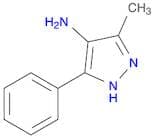
:5-methyl-3-phenyl-1H-pyrazol-4-amine
Description:
5-Methyl-3-phenyl-1H-pyrazol-4-amine, with the CAS number 112884-51-2, is an organic compound characterized by its pyrazole ring structure, which is a five-membered ring containing two nitrogen atoms. This compound features a methyl group and a phenyl group, contributing to its unique chemical properties. It is typically a solid at room temperature and may exhibit moderate solubility in organic solvents, depending on the specific conditions. The presence of the amino group (-NH2) at the 4-position of the pyrazole ring suggests potential for hydrogen bonding, which can influence its reactivity and interactions with other molecules. This compound may be of interest in medicinal chemistry due to its potential biological activity, as pyrazole derivatives are often explored for their pharmacological properties. Additionally, its structural features may allow for various synthetic modifications, making it a versatile building block in organic synthesis. Safety data should be consulted for handling and storage, as with any chemical substance.
Formula:C10H11N3
InChI:InChI=1/C10H11N3/c1-7-9(11)10(13-12-7)8-5-3-2-4-6-8/h2-6H,11H2,1H3,(H,12,13)
SMILES:Cc1c(c(c2ccccc2)n[nH]1)N
Synonyms:- 1H-pyrazol-4-amine, 3-methyl-5-phenyl-
- 1H-pyrazol-4-amine, 5-methyl-3-phenyl-
Sort by
Purity (%)
0
100
|
0
|
50
|
90
|
95
|
100
Found 2 products.
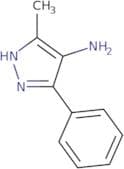
3-Methyl-5-phenyl-1H-pyrazol-4-amine
CAS:3-Methyl-5-phenyl-1H-pyrazol-4-amine is an organic compound that belongs to the class of heterocyclic amines. It has been observed in cooked meats, as well as in cigarette smoke and automobile exhaust. 3MPPA has been shown to have a potential interaction with DNA, which may lead to mutations or cancer. The functional theory of 3MPPA suggests that the molecule can form hydrogen bonds with nitrogen nucleophiles. This theory would explain its ability to interact with the nitrogenous bases thymine and cytosine, which are found in DNA.Formula:C10H11N3Purity:Min. 95%Molecular weight:173.21 g/mol