CAS 112898-27-8
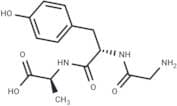
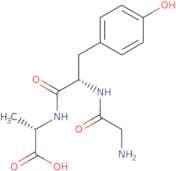
:GLY-TYR-ALA
Description:
GLY-TYR-ALA, also known as Glycyl-Tyrosyl-Alanine, is a tripeptide composed of three amino acids: glycine (Gly), tyrosine (Tyr), and alanine (Ala). This peptide is characterized by its relatively small size and specific sequence, which influences its biochemical properties and potential biological activities. The presence of tyrosine contributes to its ability to participate in various biochemical reactions, including those involving neurotransmitters and hormones, while glycine and alanine provide structural stability and flexibility. GLY-TYR-ALA may exhibit antioxidant properties due to the presence of tyrosine, which can scavenge free radicals. Additionally, peptides like GLY-TYR-ALA are often studied for their roles in cellular signaling, protein synthesis, and potential therapeutic applications. Its CAS number, 112898-27-8, allows for precise identification in chemical databases and literature. Overall, the characteristics of GLY-TYR-ALA make it a subject of interest in fields such as biochemistry, pharmacology, and nutrition.
Formula:C14H19N3O5
InChI:InChI=1/C14H19N3O5/c1-8(14(21)22)16-13(20)11(17-12(19)7-15)6-9-2-4-10(18)5-3-9/h2-5,8,11,18H,6-7,15H2,1H3,(H,16,20)(H,17,19)(H,21,22)/t8-,11-/m0/s1
SMILES:C[C@@H](C(=O)O)N=C([C@H](Cc1ccc(cc1)O)N=C(CN)O)O
Synonyms:- Glycyl-Tyrosyl-Alanine
- glycyl-L-tyrosyl-L-alanine
Sort by
Purity (%)
0
100
|
0
|
50
|
90
|
95
|
100
Found 2 products.
Glycyl-tyrosyl-alanine
CAS:Glycyl-tyrosyl-alanine has a photooxidative effect.Formula:C14H19N3O5Color and Shape:SolidMolecular weight:309.32H-Gly-Tyr-Ala-OH
CAS:H-Gly-Tyr-Ala-OH is a hydrophobic, reactive molecule that has been shown to be unstable in the presence of light and air. This compound is synthesized by the sequence: Gly-Tyr-Ala. It has been found to be an exciplex with the photooxidation product, 2-aminoacetophenone. The molecular weight of H-Gly-Tyr-Ala-OH is constant and can be determined by electrospray mass spectrometry. This molecule has shown to have a strong interaction with ovary tissue and can also produce carboxylate ions in solution.
Formula:C14H19N3O5Purity:Min. 95%Molecular weight:309.32 g/mol