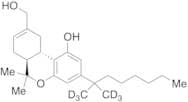
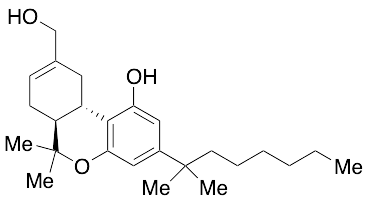
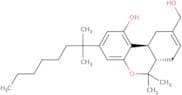
CAS 112924-45-5
:1,1-Dimethylheptyl-11-hydroxytetrahydrocannabinol
Description:
1,1-Dimethylheptyl-11-hydroxytetrahydrocannabinol, commonly referred to as a synthetic cannabinoid, is a compound that mimics the effects of natural cannabinoids found in the cannabis plant. This substance is characterized by its complex molecular structure, which includes a tetrahydrocannabinol (THC) backbone modified with a dimethylheptyl side chain and a hydroxyl group at the 11 position. Its chemical formula contributes to its lipophilicity, allowing it to interact effectively with cannabinoid receptors in the body, particularly CB1 and CB2 receptors, which are involved in various physiological processes such as pain sensation, mood regulation, and appetite control. The compound is typically studied for its potential therapeutic effects, including analgesic and anti-inflammatory properties, but it may also exhibit psychoactive effects similar to those of THC. Due to its synthetic nature, it may present different pharmacokinetic and pharmacodynamic profiles compared to natural cannabinoids, raising concerns regarding safety, legality, and potential for abuse.
Formula:C25H38O3
InChI:InChI=1/C25H38O3/c1-6-7-8-9-12-24(2,3)18-14-21(27)23-19-13-17(16-26)10-11-20(19)25(4,5)28-22(23)15-18/h10,14-15,19-20,26-27H,6-9,11-13,16H2,1-5H3/t19-,20-/m0/s1
InChI key:InChIKey=SSQJFGMEZBFMNV-PMACEKPBSA-N
SMILES:OC1=C2[C@@]3([C@@](C(C)(C)OC2=CC(C(CCCCCC)(C)C)=C1)(CC=C(CO)C3)[H])[H]
Synonyms:- (+)-Hu-210
- (6aS,10aS)-3-(1,1-Dimethylheptyl)-6a,7,10,10a-tetrahydro-1-hydroxy-6,6-dimethyl-6H-dibenzo[b,d]pyran-9-methanol
- (6aS,10aS)-9-(hydroxymethyl)-6,6-dimethyl-3-(2-methyloctan-2-yl)-6a,7,10,10a-tetrahydro-6H-benzo[c]chromen-1-ol
- 6H-Dibenzo[b,d]pyran-9-methanol, 3-(1,1-dimethylheptyl)-6a,7,10,10a-tetrahydro-1-hydroxy-6,6-dimethyl-, (6aS,10aS)-
- 6H-Dibenzo[b,d]pyran-9-methanol, 3-(1,1-dimethylheptyl)-6a,7,10,10a-tetrahydro-1-hydroxy-6,6-dimethyl-, (6aS-trans)-
- Dexanabinol
- Hu 211
- Prs 211007-000
- Sinnabidiol
- 1,1-Dimethylheptyl-11-hydroxytetrahydrocannabinol
- [6aS,(+)]-6a,7,10,10aβ-Tetrahydro-1-hydroxy-6,6-dimethyl-3-(1,1-dimethylheptyl)-6H-dibenzo[b,d]pyran-9-methanol
- (6aS,10aS)-3-(1,1-Dimethylheptyl)-6a,77,10,10a-tetrahydro-1-hydroxy-6,6-dimethyl-6H-dibenzo[b,d]pyran-9-methanol
- (6AR)-TRANS-3-(1,1-DIMETHYLHEPTYL)-6A,7,10,10A-TETRAHYDRO-1-HYDROXY-6,6-DIMETHYL-6H-DIBENZO[B,D]PYRAN-9-METHANOL
- (6AR,10AR)-3-(1,1'-DIMETHYLHEPTYL)-6A,7,10,10A-TETRAHYDRO-1-HYDROXY-6,6-DIMETHYL-6H-DIBENZO[B,D]PYRAN-9-METHANOL
- (6aS,10aS)-9-(hydroxymethyl)-6,6-dimethyl-3-(2-methyloctan-2-yl)-6a,7,10,10a-tetrahydrobenzo[c]chromen-1-ol
- (6aS,10aS)-3-(1,1-dimethylheptyl)-6,6-dimethyl-9-methylol-6a,7,10,10a-tetrahydrobenzo[c]chromen-1-ol
- (6aS)-6aα,7,10,10aβ-Tetrahydro-6,6-dimethyl-1-hydroxy-3-(1,1-dimethylheptyl)-6H-dibenzo[b,d]pyran-9-methanol
- See more synonyms
Sort by
Purity (%)
0
100
|
0
|
50
|
90
|
95
|
100
Found 3 products.
HU 211
CAS:Controlled ProductApplications HU-211 is a synthetic cannabinoid derivative that inhibits TNFα and interleukin-6 (1,2,3). HU-211 exhibits neuroprotective, antioxidant, and anti-inflammatory properties. It might be a useful agent for the treatment of stroke patients, by protecting neuronal lysosomes from nitric oxide (NO)-mediated toxicity.
References (1) Shohami, E., et al.: J. Neuroimmunol., 72, 169 (1997)(2) Ramazan, D., et al.: Neuochemical Res., 33, 1683 (2008) (3) Leker, R., et al.: J. Neurol. Sci., 162, 114 (1999)Formula:C25H38O3Color and Shape:NeatMolecular weight:386.57HU 211
CAS:Controlled ProductHU 211 is a novel synthetic cannabinoid that has been shown to have a number of pharmacological activities. It has been shown to induce neuronal death by causing mitochondrial membrane potential depolarization, which leads to the release of cytochrome c and other apoptotic factors from the mitochondria. HU 211 has also been shown to inhibit tumor growth in animal models when administered alone or in combination with cytotoxic agents like paclitaxel. The synergistic effect between HU 211 and paclitaxel is due to their ability to decrease the expression of anti-apoptotic molecules. HU 211 also inhibits transcriptional regulation, leading to inhibition of protein synthesis and cell proliferation. HU 211's antitumor activity has been demonstrated in animal models for breast, colon, lung, liver, and prostate cancers as well as bowel disease (including colitis), Parkinson's disease, and dopamine-related disorders.Formula:C25H38O3Purity:Min. 95%Molecular weight:386.57 g/mol