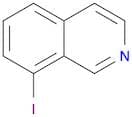
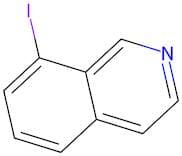
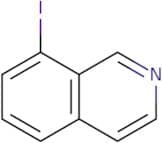
CAS 1131605-27-0
:8-Iodoisoquinoline
Description:
8-Iodoisoquinoline is a chemical compound characterized by the presence of an iodine atom at the 8-position of the isoquinoline structure, which is a bicyclic compound derived from benzene and pyridine. This compound typically exhibits a pale yellow to brownish color and is known for its aromatic properties due to the conjugated system of double bonds within the isoquinoline framework. It is generally soluble in organic solvents, such as ethanol and dichloromethane, but may have limited solubility in water. The presence of the iodine substituent can influence its reactivity, making it a useful intermediate in organic synthesis, particularly in the development of pharmaceuticals and agrochemicals. Additionally, 8-iodoisoquinoline can participate in various chemical reactions, including nucleophilic substitutions and coupling reactions, due to the electrophilic nature of the iodine atom. Its unique structural features and reactivity profile make it a valuable compound in medicinal chemistry and materials science.
Formula:C9H6IN
InChI:InChI=1S/C9H6IN/c10-9-3-1-2-7-4-5-11-6-8(7)9/h1-6H
InChI key:InChIKey=HQUAAVGLCWGKJE-UHFFFAOYSA-N
SMILES:IC=1C2=C(C=CC1)C=CN=C2
Synonyms:- 8-Iodoisoquinoline
- Isoquinoline, 8-iodo-
Sort by
Purity (%)
0
100
|
0
|
50
|
90
|
95
|
100
Found 4 products.
8-Iodoisoquinoline
CAS:Formula:C9H6INPurity:95%Color and Shape:Liquid, No data available.Molecular weight:255.0588-iodoisoquinoline
CAS:8-Iodoquinoline is a heterocyclic organic compound that contains both nitrogen and carbon. It is a colorless liquid with a pungent odor. 8-Iodoquinoline has been shown to be an experimental enhancer for cations, such as sodium, potassium, and lithium. It reacts with cations in the gas phase to form the corresponding iodoquinolinate anion, which is then reacted with electrophiles to yield products such as alcohols or amines. 8-Iodoquinoline also exhibits reactivity towards isocyanides and isomerizes to give the corresponding 1-isocyanide. The 2-isomers are also possible but less stable than the 1-isomer. This compound can also react with tert-butyl disulfide in the presence of titanium tetrachloride to yield a disulfide derivative.Formula:C9H6INPurity:Min. 95%Molecular weight:255.06 g/mol