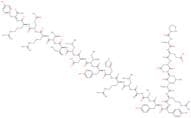
CAS 113662-54-7
:neuropeptide Y fragment 13-36
Description:
Neuropeptide Y fragment 13-36 is a peptide derived from neuropeptide Y (NPY), a neurotransmitter involved in various physiological processes, including appetite regulation, circadian rhythms, and stress response. This specific fragment consists of 24 amino acids and retains significant biological activity, particularly in modulating food intake and energy balance. It interacts with neuropeptide Y receptors, influencing neuronal signaling pathways. The CAS number 113662-54-7 uniquely identifies this compound in chemical databases, facilitating its study and application in research. Characteristically, neuropeptide Y fragment 13-36 is soluble in aqueous solutions, which is typical for peptides, and it may exhibit stability under physiological conditions. Its role in neurobiology makes it a subject of interest in studies related to obesity, metabolic disorders, and neurodegenerative diseases. Overall, this fragment serves as a valuable tool for understanding the complex interactions of neuropeptides in the central nervous system and their potential therapeutic implications.
Formula:C135H209N41O36
Synonyms:- Neuropeptide Y 13-36, Porcine
- H-Pro-Ala-Glu-Asp-Leu-Ala-Arg-Tyr-Tyr-Ser-Ala-Leu-Arg-His-Tyr-Ile-Asn-Leu-Ile-Thr-Arg-Gln-Arg-Tyr-NH2
Sort by
Purity (%)
0
100
|
0
|
50
|
90
|
95
|
100
Found 4 products.
Neuropeptide Y (13-36) (porcine)
CAS:This fragment is able to compete with the intact NPY for essentially all binding sites in rat brain. However, it is less potent than the native peptide in its NPY-receptor binding affinity.Formula:C135H209N41O36Purity:96.3%Color and Shape:Yellowish PowderMolecular weight:2982.4Neuropeptide Y 13-36 (porcine)
CAS:Neuropeptide Y 13-36 (porcine) is a selective neuropeptide Y2 receptor agonist.Formula:C135H209N41O36Color and Shape:SolidMolecular weight:2982.408Neuropeptide Y (13-36) (porcine) trifluoroacetate salt
CAS:Please enquire for more information about Neuropeptide Y (13-36) (porcine) trifluoroacetate salt including the price, delivery time and more detailed product information at the technical inquiry form on this pageFormula:C135H209N41O36Purity:Min. 95%Molecular weight:2,982.36 g/molNPY (Porcine, 13-36)
CAS:NPY is a peptide that belongs to the family of neuropeptides. It is an activator of G-protein coupled receptors, which are proteins found on the surface of cells. NPY binds to these receptors and triggers a signal transduction cascade that leads to increased activity in ion channels. This results in an increase in the permeability of the membrane and the influx of calcium ions into cells, which can cause cell death or inhibition of cell growth. NPY has been shown to be involved in many physiological processes, including regulation of food intake, body weight, water balance, reproduction, and immune function. NPY has also been shown to inhibit receptor binding by antibodies.
Formula:C135H209N41O36Purity:Min. 95%Molecular weight:2,982.4 g/mol