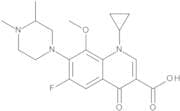
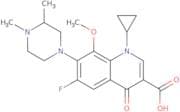
CAS 114213-69-3
:N-Methyl Gatifloxacin
Description:
N-Methyl Gatifloxacin is a synthetic fluoroquinolone antibiotic, primarily used for its antibacterial properties. It is characterized by its broad-spectrum activity against various Gram-positive and Gram-negative bacteria, making it effective in treating a range of infections. The compound features a bicyclic core structure typical of fluoroquinolones, which includes a piperazine ring and a carboxylic acid functional group, contributing to its mechanism of action that involves the inhibition of bacterial DNA gyrase and topoisomerase IV. N-Methyl Gatifloxacin is known for its favorable pharmacokinetic profile, including good oral bioavailability and tissue penetration. Additionally, it exhibits a relatively low incidence of side effects compared to other antibiotics, although resistance can develop with overuse. The substance is typically administered in clinical settings for treating respiratory and urinary tract infections, among others. As with all antibiotics, appropriate use is crucial to minimize the risk of resistance development.
Formula:C20H24FN3O4
Synonyms:- 1-Cyclopropyl-7-(3,4-dimethyl-1-piperazinyl)-6-fluoro-1,4-dihydro-8-methoxy-4-oxo-3-quinolinecarboxylic Acid
Sort by
Purity (%)
0
100
|
0
|
50
|
90
|
95
|
100
Found 4 products.
3-Quinolinecarboxylic acid, 1-cyclopropyl-7-(3,4-dimethyl-1-piperazinyl)-6-fluoro-1,4-dihydro-8-methoxy-4-oxo-
CAS:Formula:C20H24FN3O4Purity:%Color and Shape:SolidMolecular weight:389.4207N-Methyl Gatifloxacin
CAS:Controlled ProductApplications An impurity of Gatifloxacin.
References Naber, C., et al.: Antimicrob. Agents Chemother., 45, 293 (2001), Herzler, M., et al.: J. Anal. Toxicol., 27, 233(2003), Pragst, F., et al.: Clin. Chem. Lab. Med., 42, 1325 (2004),Formula:C20H24FN3O4Color and Shape:NeatMolecular weight:389.42N-Methyl gatifloxacin
CAS:N-Methyl gatifloxacin is a fluoroquinolone antibiotic that inhibits the DNA gyrase and topoisomerase IV, which are enzymes that maintain the integrity of bacterial DNA. It binds to bacterial 16S ribosomal RNA and inhibits protein synthesis, leading to cell death by inhibiting the production of proteins vital for cell division. Gatifloxacin has been shown to be effective against methicillin-resistant Staphylococcus aureus (MRSA) and Clostridium perfringens, although is not active against acid-fast bacteria such as Mycobacterium tuberculosis or Mycobacterium avium complex. Gatifloxacin has shown anti-inflammatory properties, which may be due to its inhibition of prostaglandin synthesis. N-methyl gatifloxacin is an amide prodrug that is hydrolyzed in vivo to its active form, gatiflFormula:C20H24FN3O4Purity:Min. 95%Molecular weight:389.42 g/mol